DOSSIER 082 / DIGITAL FOLKLORE
Ukraine Hit the Servers. Did the Right-Wing Bots Go Quiet?
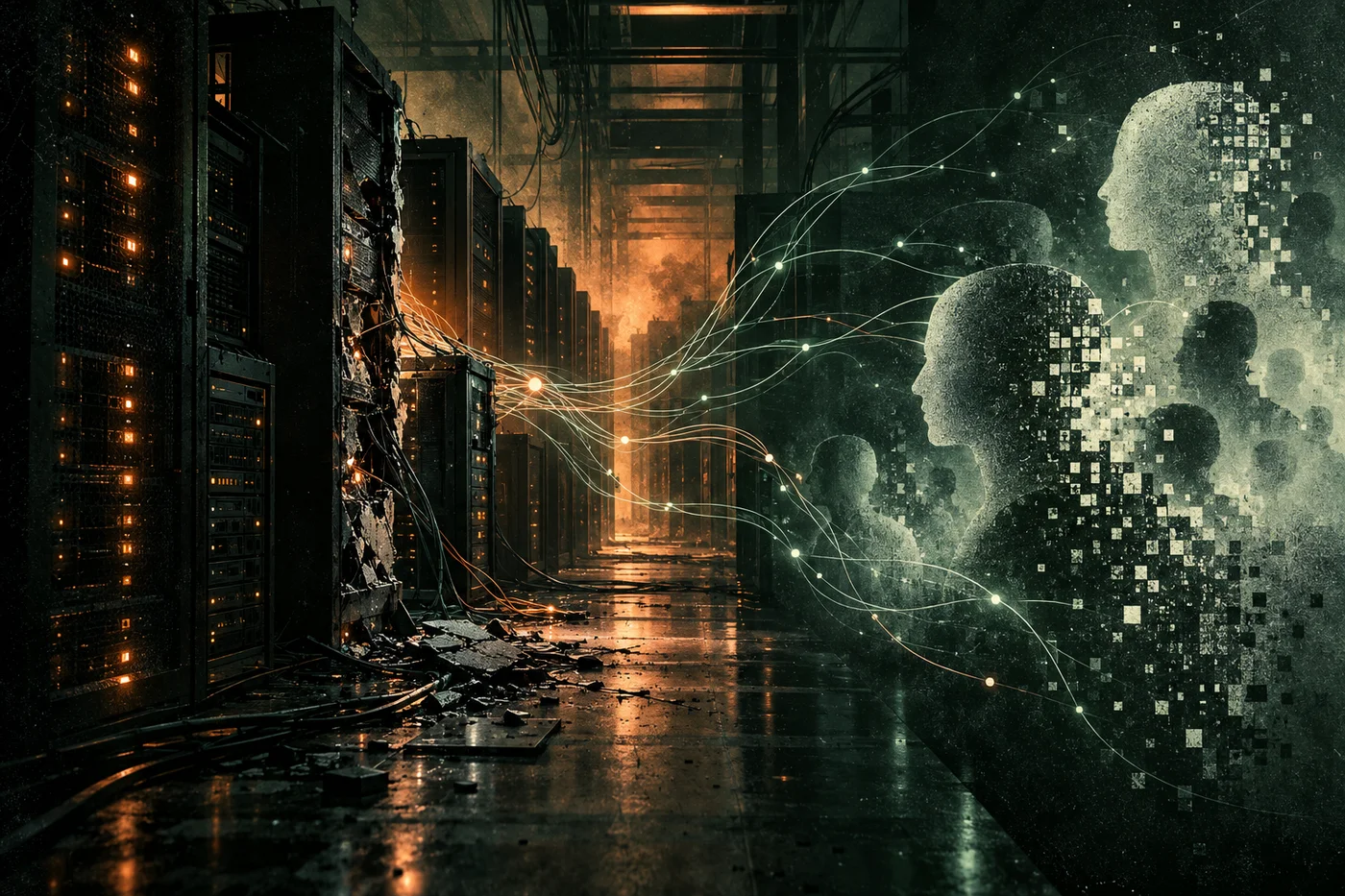
The servers went dark. The story about who disappeared spread everywhere.
Unsupported applies to the broad political-account blackout claim, not to the documented strikes or the existence of Russian influence operations. A particular operation could have been disrupted without being identified in these sources.
THE RECORD, IN BRIEF
Did Ukraine’s Yandex strikes reduce right-wing bot activity?
The reviewed evidence establishes network disruption but does not establish the claimed political-account blackout. The widely shared traffic chart and political-account activity measure different things.
On 8 October, Yandex confirmed that drones had hit its data center in Sasovo. A week later, people were arguing about whether the attack had reached into their own phones. The replies seemed quieter, they said. The accounts cheering MAGA, Germany's AfD or Britain's Reform UK seemed to have lost their audience. A graph showing automated traffic falling off a cliff supplied the missing image: somewhere in Russia, somebody had pulled the plug. Follow that graph back to its source, though, and the story becomes stranger. The outage was measurable. The supposed disappearance of political accounts was a different investigation, and almost everyone was treating the two as the same event.
01 / The building behind the graph
Reuters reported the Sasovo strike on 8 October, citing Yandex itself. The company said the facility had been temporarily shut down and workloads were being transferred elsewhere. The site had housed two of its supercomputers, but a report that a building was hit did not establish the fate of every machine inside it. This matters when the story is retold as the destruction of an entire bot army: even the physical inventory was still uncertain.
The damage landed in an economy already fighting over communications infrastructure. Reuters described reciprocal attacks spreading beyond energy installations into other parts of civilian economic life. By the following days, reporting also identified disruptions involving Kaluga and Vladimir. There is a small date trap here: an outage starting late on 7 October UTC can belong to 8 October on a local clock. Comparing an attack report with a traffic chart requires putting both on the same clock before drawing a connection.
This file does not contain an interview with a Sasovo technician, a verified account from inside a struck server room, or an inventory of destroyed equipment. The closest contemporary participant account reviewed here is the company's public statement, carried by Reuters. It describes an operator responding to damage. It cannot tell us which people were behind hostile replies on an American or European feed.
02 / The claim reached the president
On 12 October, Volodymyr Zelenskyy made the connection publicly in an address to the Warsaw Security Forum. He said the strikes followed Russia's attacks on Ukrainian data centers and described social platforms becoming easier to breathe on, with fewer provocations and bots. The official transcript preserves his argument. He offered an observation about the atmosphere online and an explanation for it; the address did not publish an account list, a platform dataset or a reproducible count.
That is the strongest version of the believer's case: a physical intervention happened, a visible technical signal collapsed, and people thought they could feel the consequence in spaces they used every day. It sounds like an accidental experiment. If a hidden factory loses power and its product disappears at the same moment, the coincidence deserves attention. A reader who already suspects manufactured outrage would naturally want to follow it.
Euronews recorded the discussion reaching figures as different as Laura Loomer, Garry Kasparov and Michael McFaul, alongside claims about Reform UK and AfD activity. Their involvement documents the reach of the story. It does not supply a shared measurement of what vanished. Someone reporting a calmer feed is describing their experience of a recommendation system, a particular set of accounts and a particular stretch of time. Preserve that account as a lead, then ask whether another observer can find the same change.
03 / Two kinds of bot entered the same sentence
Yandex's own webmaster instructions describe a robot that visits pages so they can appear in search. A publisher may see it fetching an article even when nobody is sharing that article. It does not need a profile picture, a political allegiance or an audience. Taking that crawler offline changes the publisher's server logs without requiring a single social-media account to stop posting.
Cloudflare’s 14 October investigation separated Yandex Search from Yandex.Cloud. Search traffic was overwhelmingly automated and mostly verified crawling. Its broader telemetry did not establish a global collapse in malicious automation. HTTP requests are a different measurement from political profiles.
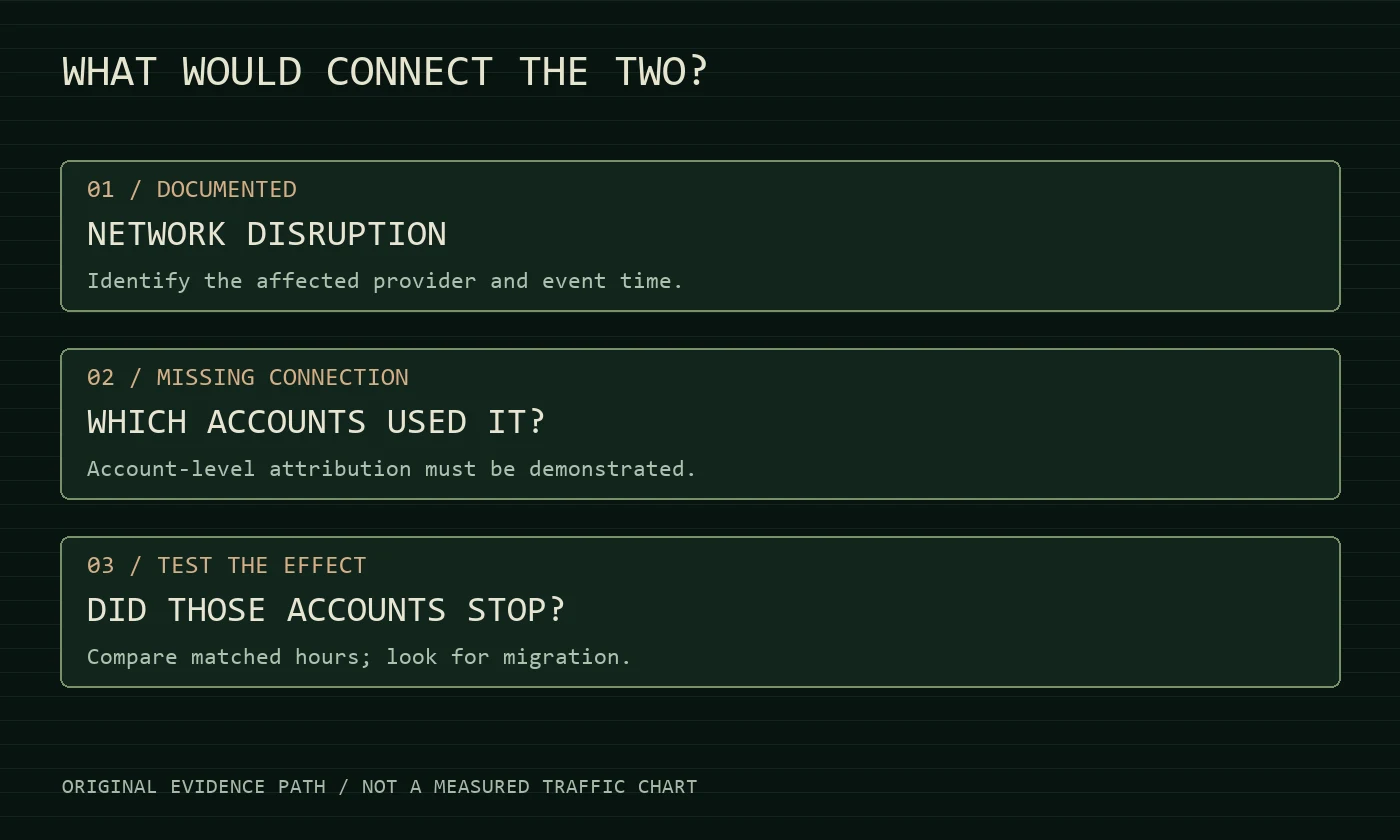
Consider what would have to be added to turn that chart into the claim circulating online. First identify the accounts. Then establish their connection to the affected infrastructure. Then show that those same accounts stopped acting when that infrastructure failed. The network chart supplies none of those account identities. Writing a party's name beside its falling line cannot fill the gap.
There is another distinction inside the damage. A service can become unreachable without being permanently destroyed; a workload can stop at one address and resume at another. Calling every outage a destruction, or every automated request a propagandist, makes a cleaner headline while making the event harder to understand.
04 / Researchers went looking for the missing accounts
Graphika examined the named political communities rather than inferring their condition from Yandex's network. Its 13 October report found no unusual loss of active accounts or heavy posters in the Western communities under discussion. In its AfD-related sample, Sunday posts fell about 4% against the previous Sunday, within a much wider normal range. MAGA mentions rose in the first eight hours after the Vladimir strike. These are observations in Graphika's datasets, not a complete inventory of every account on every platform.
The company also found lower activity in Russian-speaking spaces, including Russian-language Telegram channels. It did not establish what caused that reduction. Its newest dates were still partly collected when the analysis was pulled. That limitation belongs beside the result: preliminary social data can change as collection catches up.
Renée DiResta separately asked researcher Kate Starbird to inspect the AfD claim. The preliminary aggregate conversation chart she published showed no matching cliff. DiResta emphasized shrinking access to platform data and the difficulty of testing claims about influence. Aggregate mentions can stay steady even if a particular covert network suffers an outage; they can also fall because ordinary users are spending Sunday somewhere else. Neither result automatically identifies the accounts that matter.
The most useful disagreement here concerns the unit being counted. A human operator could lose access, a crawler could stop, a topic could become less interesting, or a platform could recommend different posts. Those events can coexist. An investigation needs to say which one it found before it starts explaining why.
05 / The second graph had problems of its own
DW's fact-check examined an AfD activity graphic that circulated alongside the genuine traffic story. It lacked a usable source and platform identification and contained timing inconsistencies. CeMAS managing director Josef Holnburger told the fact-checkers that website bot traffic and inauthentic social-network behavior were different measurements. His response challenged the claimed connection to the strikes, rather than denying that influence operations exist.
A chart can acquire authority simply by traveling beside a better chart. Once the authentic network outage has established that something dramatic happened, an unattributed political graph may feel like the next piece of the same investigation. The reader remembers two falling lines. The sources, time zones and denominators disappear from memory.
Keep the two exhibits separate. One comes from a named infrastructure company and has an identifiable measurement. The other must earn its own place in the record. A screenshot without the underlying series, collection method and publication time cannot carry an accusation about a party's supporters. Nor should a troublesome screenshot be used to dismiss the verified outage beside it.
06 / A propaganda network does not need a Russian return address
There is a documented reason people take Russian bot allegations seriously. In July 2024, the US Justice Department announced action involving two domains and 968 social-media accounts that investigators alleged formed a Russian government-operated, AI-assisted bot farm. The accompanying FBI affidavit follows registrations and infrastructure. It is an allegation supported by an investigative record, not a general license to classify an unfamiliar account as Russian.
Qurium's technical investigation of the separate Doppelganger operation traced infrastructure operating through European data centers and layers of redirects. It described a supply chain that crossed company and national boundaries. That case is relevant because it demonstrates why the operator's nationality and the server's location cannot be treated as interchangeable. It does not establish where every operation lives, or where any particular Yandex customer moved.
Cloudflare also tracked matching malicious web requests moving to other providers. That example concerned web requests rather than political posting. Watching one provider go quiet could miss activity resuming elsewhere, so a convincing account-level investigation would need to look for recovery too.
The question worth pursuing is consequently specific. Was a named influence operation dependent on the damaged facilities, and did that dependency leave a measurable interruption? A broad assertion that the right wing disappeared sweeps genuine voters, paid influencers, automated amplifiers and covert operators into one category. It becomes less informative precisely where it sounds most decisive.
07 / What would make the blackout case convincing?
My starting point would be a list of accounts selected before looking for a decline. How were they identified as coordinated, and what evidence connects them to Russia? Keep that judgment separate from whether their politics are objectionable. A person with a strong opinion can post at an exhausting rate without being a machine or taking orders from abroad.
Next, preserve the timestamps and compare matching hours across several weeks. Look at account activity as well as views: falling views can reflect distribution rather than silence. Include unrelated communities and providers as controls. Mark platform outages, suspensions and major news events. An apparent effect that disappears when the window moves a few hours is a weak basis for a claim about military action.
Finally, show the infrastructure connection and check for recovery elsewhere. A platform disclosure, hosting records or a properly documented technical investigation could supply information missing from a viral screenshot. Publish the method and the failures too. Otherwise each observer can choose the accounts and hours that make their preferred story work.
As of 15 October 2026, this file treats the strikes and network disruption as documented, the sweeping political-blackout claim as unsupported by the reviewed evidence, and disruption to a particular unidentified operation as an open possibility. The distinction could change with new account-level evidence. For now, a reader can follow the address, the telemetry and the researchers' counterchecks in the Paper Trail, then decide which missing record would be worth obtaining first.
QUESTIONS LEFT ON THE DESK
The questions readers bring.
FAQ & search review: 2026-10-15 · Source links identify the record behind each answer. This date does not certify a new investigation of every chapter.
Were Yandex data centers hit by Ukrainian drones?
Yandex confirmed the Sasovo strike in reporting published on 8 October 2026. Subsequent reports described other affected facilities. The exact destruction of individual machines is not established here.
Why did people connect the strikes with MAGA, AfD and Reform UK bots?
Accounts described quieter feeds, while a sharp network-traffic drop circulated as apparent corroboration. Zelenskyy also made a public connection. These claims require account-level evidence beyond an outage chart.
What evidence would establish a political-bot blackout?
A reproducible account list, evidence of coordinated operation and relevant hosting, matched activity before and after the strikes, and checks for migration or unrelated changes would strengthen the case.
Compare the records: The Bot Swarm: Is the Internet Empty? · CIA relationships with journalists · The Political Deepfake: Who Said Those Words?.
The allegation, in brief
Ukrainian strikes on Yandex data centers silenced Russian-run accounts amplifying MAGA, AfD and Reform UK politics.
Where the archive stands
Drone strikes and network disruption are documented. The viral network chart measured automated web requests; reviewed community analyses do not establish the claimed collapse of right-wing political accounts.
I would start with the accounts that supposedly disappeared, then ask where they were hosted and whether they came back.
ARCHIVIST’S NOTE / EXPANDED RESEARCH: 15 OCT 2026
THE SHELF BEHIND THE FILE
For further reading
Read the historical operations first, then the account of how online audiences carry a story.
As an Amazon Associate I earn from qualifying purchases. Purchases through these links may earn this archive a commission.
- THE WATCHER’S
FAVORITE 01 / 2020 / 2021 paperback
Active Measures: The Secret History of Disinformation and Political Warfare
Start here for the longer history of organized deception and the move into online operations. Selected for relevance and the publisher’s documented critical reception, not Amazon customer ratings.
View book on AmazonBook & source detailsWhy this pick?
The Watcher’s Favorite is an editorial choice based on subject fit and published critical reception. Amazon customer ratings and current availability were not verified.
The stamp is an editorial recommendation informed by published reviews, source quality, and relevance. It is not a claim about the highest Amazon customer rating. Selection source.
 02 / 2024
Invisible Rulers: The People Who Turn Lies into Reality
For the relationship between influencers, audiences and the stories they circulate. DiResta also wrote one of the analyses cited in this file; the recommendation is disclosed rather than treated as independent corroboration.
View book on AmazonBook & source details
A place on this shelf is not a verdict on every claim inside. Selection checked 15 October 2026. Cover artwork belongs to its respective rights holders; cover sources & editions. Links open a specific edition. Cover artwork may show a different edition; check the format, availability, and price on Amazon before buying.
A QUESTION LEFT IN THE MARGIN / EDITORIAL PROMPT
Bring one source.
Which specific accounts went quiet after the Yandex strikes? Bring timestamps, a comparison period and evidence of coordination—what would distinguish an outage from an ordinary weekend?
A useful first note: the source, what it establishes, and what it leaves open.
FOLLOW ANOTHER THREAD
Follow this thread.
Follow the distinction between automated traffic, covert influence and political amplification.
 TAKEOVER UNPROVENDOSSIER 072 / FICTIONAL ART
The Bot Swarm: Is the Internet Empty?
The traffic is real. The people-count is another question.
 DocumentedDOSSIER 060
CIA relationships with journalists
The relationship was acknowledged. The legend grew wider.
 DISPUTE IN PROGRESSDOSSIER 073 / FICTIONAL ART
The Political Deepfake: Who Said Those Words?
A familiar face. An invented performance. A two-page demand.