DOSSIER 073 / DIGITAL FOLKLORE
The Political Deepfake: Who Said Those Words?
A familiar face. An invented performance. A two-page demand.
Contested describes the campaign dispute and unresolved legal allegations. It does not mean every issue of authenticity is equally uncertain.
The letter is dated 30 September 2026. Two pages, addressed to a congressman, with a footnote leading to a video. Its central accusation is disarmingly simple: the woman on the screen never said those words. The legal language follows. Before deciding who is manipulating whom, open the letter and separate the voice from the speaker.
01 / The candidate who recognized her face
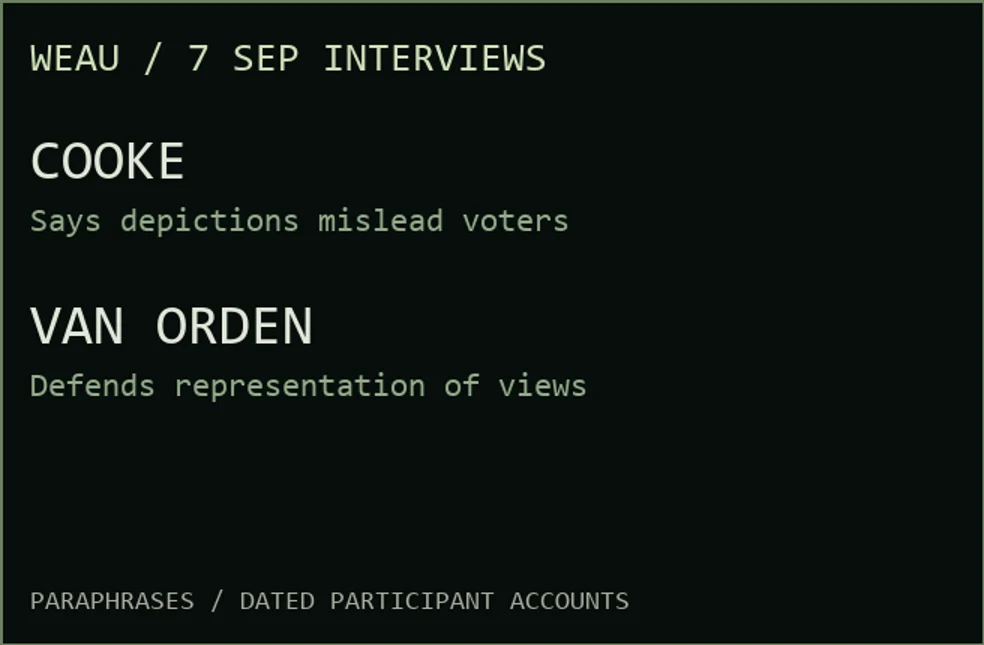
In Wisconsin’s congressional contest, Rebecca Cooke and incumbent Derrick Van Orden were already fighting over AI-generated depictions before the letter arrived. WEAU’s Kim Leadholm interviewed both candidates for a report published on 7 September. Cooke described frustration and uncertainty among voters who could not tell whether a depicted appearance was real. This is a named participant’s contemporary account of the dispute; the report does not independently measure how many voters were confused.
Van Orden gave a different defense to the same reporter. He maintained that the videos represented Cooke’s policies and values. That response is important because it places the dispute at the boundary between political characterization and a counterfeit appearance. A campaign can argue that an opponent’s policy has a particular consequence. Putting invented speech into a recognizable simulation of that opponent presents an additional question: will a viewer understand that the performance itself was manufactured?
Geoff Peterson, a political-science professor at the University of Wisconsin–Eau Claire, told WEAU that AI depictions could mislead in ways ordinary statements about an opponent do not. The difference lies in the apparent witness. A sentence from an adversary announces its author. A moving likeness can appear to supply the adversary’s missing proof.
02 / A legal demand is a record, not a verdict
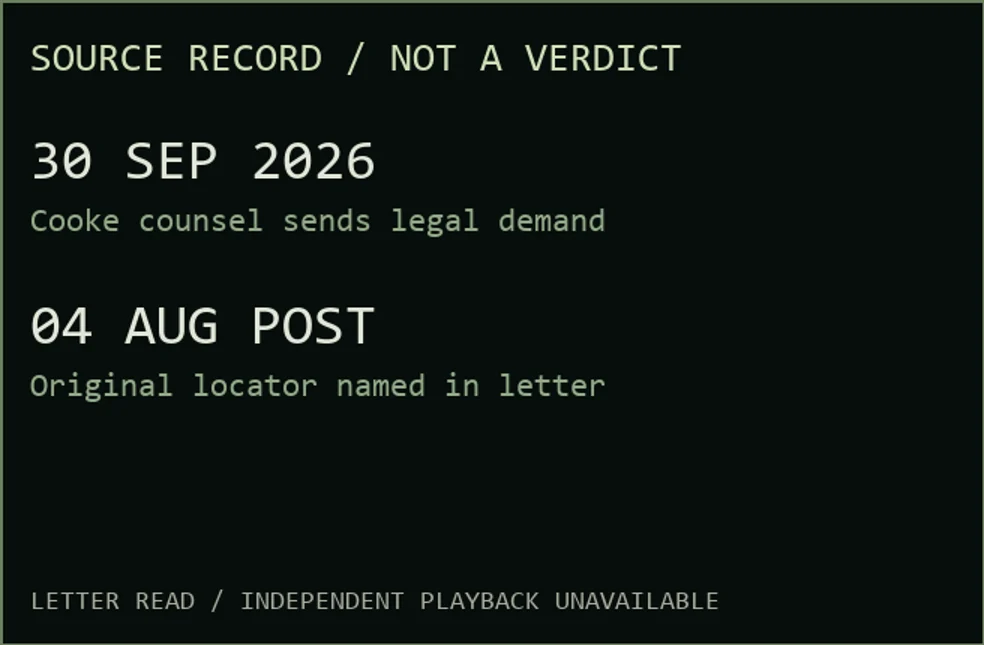
The September 30 letter was written by Ben Stafford of Elias Law Group on behalf of Cooke for Congress. It identifies an August 4 post on Van Orden’s X account and alleges that it depicted Cooke campaigning in Eau Claire with Joe Biden behind her. Counsel says the clip attributed statements and positions to Cooke that she never expressed. The letter accuses Van Orden of harming her reputation and warns that the campaign will evaluate legal options if the conduct continues.
Those statements establish what the campaign’s lawyer alleged and demanded. They do not establish a court’s conclusion about falsity, intent, damages or liability. This review read both pages of the publicly linked letter. The original-post address is included in the Paper Trail, but independent playback of that post was unavailable during this review. Its specific staging is therefore attributed to the letter, rather than presented as this archive’s own frame-by-frame examination.
WEAU’s September 30 report links that document. The visible sequence is consequently stronger than an anonymous screenshot: interviews on September 7, a dated legal demand on September 30, and an identified original-post locator. The missing item remains important. A preserved full clip, including its accompanying text and any disclosure at the time of posting, would allow closer scrutiny of what a viewer was actually shown.
03 / The fake recording has a real history
This concern did not begin with the Wisconsin letter. Before New Hampshire’s January 2024 presidential primary, a robocall used an imitation of Joe Biden’s voice and told recipients not to vote. In September 2024, the FCC announced a six-million-dollar civil forfeiture against consultant Steve Kramer over the spoofed-call campaign. That announcement is an agency’s enforcement record, not a claim that every synthetic political recording is unlawful under the same provision.
The later outcome also belongs in the file. AP reported in May 2025 that a New Hampshire jury acquitted Kramer of voter-suppression and candidate-impersonation charges. The criminal verdict and the FCC action are different proceedings. Omitting the acquittal would turn a real example of manipulated audio into a misleading legal morality play. A documented recording can be synthetic even when a particular criminal prosecution does not secure a conviction.
The wider suspicion is that a political audience can be steered by evidence that never existed: an admission, an endorsement, an apparently candid conversation. The documented cases establish that people can manufacture such material. They do not establish one central operation behind all election clips, or that any disputed video is synthetic merely because its subject denies it. The file has to begin again with each artifact.
04 / What would settle the image—and what would not
NIST’s synthetic-content report surveys detection, watermarking and provenance. It describes an uneven technical landscape, including error probabilities, metadata that can be inaccurate, and detectors that perform better on some generators than others. A detector score is a lead. It should not be promoted to a courtroom-style verdict simply because it arrives with a decimal point.
Content Credentials offer a different tool: a record of a file’s history bound to the content. C2PA’s own explainer cautions that credentials validate provenance information rather than judging whether the assertions are true. A verified origin can help establish who signed a claim about an image. It cannot certify the honesty of everything said in that image. Absence of a credential is not proof of fabrication either.
For this dispute, the better trail is the complete original post, a preserved copy of the clip, disclosure visible to viewers, the creation history if obtainable, and both parties’ dated statements. Motive remains a separate inquiry. Cooke’s counsel alleges political advantage; Van Orden’s earlier interview defends the videos as representations of her views. The archive can report those positions without deciding disputed legal intent.
The unsettling possibility is not just that a fake will be believed. It is that real material will become easier to dismiss. If every damaging recording can be called AI, authenticity becomes another campaign battlefield. That is an investigative question about how this dispute functions, not evidence that either candidate secretly controls a larger operation. The letter tells us where to start. It does not tell us where the case will end.
The allegation, in brief
Synthetic campaign depictions are being used to manufacture apparent statements by political opponents and influence voters.
Where the archive stands
Cooke’s September 30 legal demand and WEAU’s interviews establish a specific dispute over AI depictions. The letter’s allegations are not a court finding. Independent playback of its identified August 4 post was unavailable during this review; staging details are attributed to counsel.
Find the complete recording before trusting either the accusation or the denial.
ARCHIVIST’S NOTE / EXPANDED RESEARCH: 03 OCT 2026
THE SHELF BEHIND THE FILE
For further reading
Background on online amplification and evidence. These books predate the Cooke–Van Orden dispute and do not determine its legal outcome.
As an Amazon Associate I earn from qualifying purchases. Purchases through these links may earn this archive a commission.
- THE WATCHER’S
FAVORITE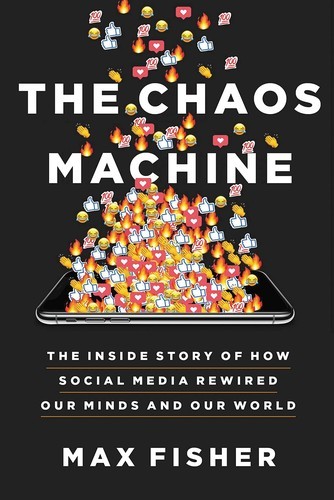 01 / Investigative journalism
The Chaos Machine
The platforms, incentives, and algorithms that help rumors travel.
View book on AmazonBook & source detailsWhy this pick?
Booklist starred review and favorable New York Times Book Review reception, documented by the publisher.
The stamp is an editorial recommendation informed by published reviews, source quality, and relevance. It is not a claim about the highest Amazon customer rating. Selection source.
 02 / Science / critical thinking
The Demon-Haunted World
A working kit for examining extraordinary claims without losing your sense of wonder.
View book on AmazonBook & source details
A place on this shelf is not a verdict on every claim inside. Selection checked 2 October 2026. Cover artwork belongs to its respective rights holders; cover sources & editions. Links open a specific edition. Cover artwork may show a different edition; check the format, availability, and price on Amazon before buying.
A QUESTION LEFT IN THE MARGIN / EDITORIAL PROMPT
Bring one source.
When does political satire become counterfeit evidence? Which detail in the complete post would change your judgment in this dispute?
A useful first note: the source, what it establishes, and what it leaves open.
FOLLOW ANOTHER THREAD
Follow this thread.
Counted machine activity does not establish who fabricated a particular recording.
 TAKEOVER UNPROVENDOSSIER 072 / FICTIONAL ART
The Bot Swarm: Is the Internet Empty?
The traffic is real. The people-count is another question.
 DocumentedDOSSIER 060
CIA relationships with journalists
The relationship was acknowledged. The legend grew wider.
 UnsupportedDOSSIER 045
The Dead Internet Theory
The crowd keeps talking. Is anyone still there?