DOSSIER 072 / DIGITAL FOLKLORE
The Bot Swarm: Is the Internet Empty?
The traffic is real. The people-count is another question.
The Unsupported label applies to the covert-replacement interpretation. The existence of automated traffic is documented.

A website receives a request. Then another. Then ten thousand more. The counter rises, but a request has no face. In the autumn of 2026, the old suspicion that the internet has become an empty room found something more substantial than a strange comment thread: measurements. The trouble begins when those measurements are made to answer a question they never asked.
01 / The September report on the desk
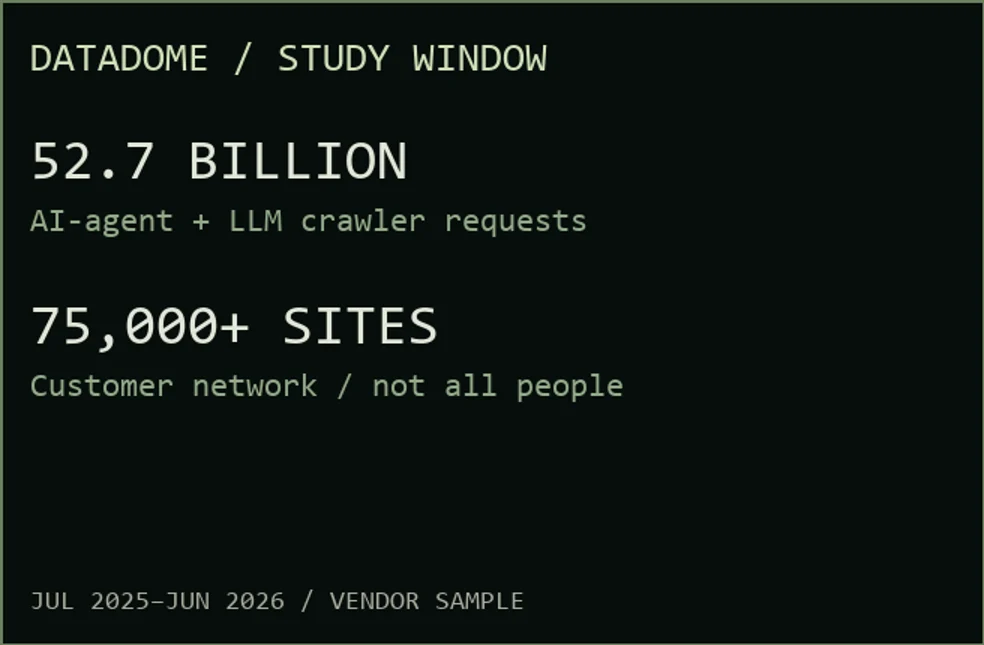
DataDome’s 2026 report follows traffic from July 2025 through June 2026 across more than 75,000 customer websites. It is a large observation window belonging to a company that sells protection against automated traffic. That ownership matters. The report is evidence of what its systems classified on the sites they served; it is also a commercial argument about a problem the company offers to solve.
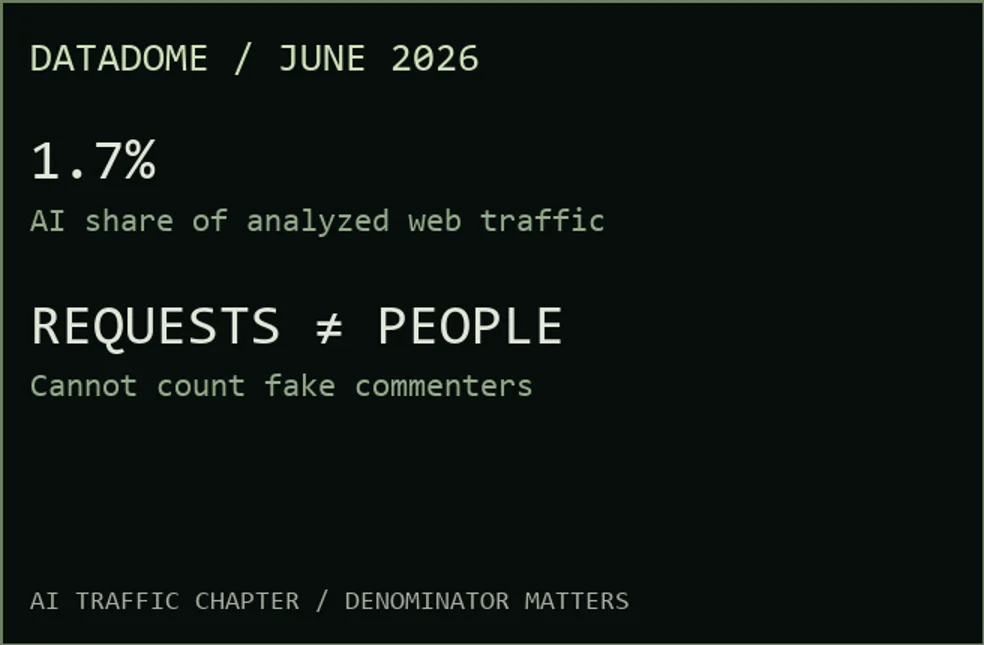
Its AI chapter reports 52.7 billion requests attributed to AI agents and language-model crawlers over the study period. Monthly volume rose from roughly 3.5 billion in July 2025 to 6.6 billion in June 2026. The chapter describes an 82.3 percent increase between those endpoints. By June, however, that category accounted for 1.7 percent of the total web traffic analyzed. The enormous count and the small share can both be correct. A headline that retains one and drops the other changes the story.
This file examines that change in traffic. The older Dead Internet dossier follows the wider folklore of a covert replacement of human activity. Keeping them separate prevents a fresh vendor report from being used as a retroactive certificate for every claim attached to the theory.
02 / What the machines were actually doing
Cloudflare supplies a second view. Its July 2026 essay reports that AI-training activity accounted for 52 percent of crawler requests classified by purpose in June, compared with 22 percent in spring 2025. That percentage describes crawlers. It does not describe the share of people in a discussion, the number of fake friendships, or the fraction of everything read on the internet that was written by a machine.
The company’s broader argument concerns publishers: systems can consume material without sending readers back to the people who made it. Cloudflare advocates mechanisms to control and monetize that access. The conflict is concrete. A publisher may need search discovery while resisting bulk extraction. The same infrastructure can carry a human reader, a search indexer, an assistant acting for a person, and an unwanted scraper. Calling all four visitors does not make them equivalent.
DataDome also explains a complication in its own bot measurements: approximately 60 percent of its customers operate behind a content-delivery network with basic filtering. Its system sits downstream and sees traffic that passes that layer. A blocked request and a request that reaches the measurement point belong to different populations. There is no honest way to average unlike percentages until their populations and classification methods are understood.
Imagine one automated process fetching a hundred pages while one person reads a single page. The process dominates the request count; it does not prove that a hundred people vanished. This is a numerical example, not a measurement from either report. It identifies the inference that has to be tested.
03 / The believers’ strongest case
The theory’s appeal starts with an experience: a crowded feed that feels oddly vacant. TIME’s September 2025 account traces its spread to a 2021 Agora Road post by the pseudonymous IlluminatiPirate. The original story proposed something much larger than spam—an internet taken over by powerful interests. TIME also recorded Sam Altman acknowledging an apparent abundance of language-model-run accounts on X. An executive’s impression is a participant’s observation, not a platform-wide audit.
The serious version of the believer’s argument does not require every account to be fake. If a relatively small number of automated actors can manufacture apparent agreement, occupy searches, or drown out replies, a person may encounter an artificial social environment even while other people remain online. Raw request totals cannot answer that question. It calls for evidence about the particular accounts, their behavior and relationships, and what real readers actually saw.
This leaves two claims that should never be smuggled into one another. The first is that substantial automation changes the web. The contemporary reports provide evidence for that. The second is that a single concealed operation replaced the human public. Neither a synthetic reply nor a crawler graph identifies that operation. It needs an operator, a mechanism and records connecting them.
04 / Count the traffic. Then find the people.
The skeptical response should not be that the reader imagined the machines. The machines are in the measurements. The objection is to the jump from observed automation to universal orchestration. A report about selected websites cannot tell us whether a particular conversation contains genuine participants. A report about crawlers cannot count the motives of the humans directing them.
A useful investigation begins with a named platform and a dated sample. It states whether it counted requests, posts, accounts or people. It explains how automation was identified, what escaped classification, and how upstream filtering affected the result. If the conclusion concerns manipulation, it then supplies account-level or campaign-level evidence rather than replacing that evidence with a large number from a different system.
The next record worth opening is narrower than the theory: evidence that a particular apparent crowd was manufactured, and evidence of who manufactured it. Until that arrives, the September report belongs in the automation drawer. The drawer marked coordinated takeover remains open, but its label is not a finding.
The allegation, in brief
Measured automated traffic proves that a concealed operation has replaced the human internet.
Where the archive stands
Large vendor-network samples document extensive automation and rising AI traffic. Request counts and crawler shares do not establish how many people participate online, or identify a coordinated secret takeover.
A request is not a person. Keep the denominator in the file.
ARCHIVIST’S NOTE / EXPANDED RESEARCH: 03 OCT 2026
THE SHELF BEHIND THE FILE
For further reading
Platform incentives and critical thinking. These contextual books do not measure 2026 bot traffic or validate a hidden takeover.
As an Amazon Associate I earn from qualifying purchases. Purchases through these links may earn this archive a commission.
- THE WATCHER’S
FAVORITE 01 / Investigative journalism
The Chaos Machine
The platforms, incentives, and algorithms that help rumors travel.
View book on AmazonBook & source detailsWhy this pick?
Booklist starred review and favorable New York Times Book Review reception, documented by the publisher.
The stamp is an editorial recommendation informed by published reviews, source quality, and relevance. It is not a claim about the highest Amazon customer rating. Selection source.
 02 / Science / critical thinking
The Demon-Haunted World
A working kit for examining extraordinary claims without losing your sense of wonder.
View book on AmazonBook & source details
A place on this shelf is not a verdict on every claim inside. Selection checked 2 October 2026. Cover artwork belongs to its respective rights holders; cover sources & editions. Links open a specific edition. Cover artwork may show a different edition; check the format, availability, and price on Amazon before buying.
A QUESTION LEFT IN THE MARGIN / EDITORIAL PROMPT
Bring one source.
If a thousand requests come from one bot, what would actually prove that the crowd in your favorite discussion is fake? Bring a dated example and explain what you counted.
A useful first note: the source, what it establishes, and what it leaves open.
FOLLOW ANOTHER THREAD
Follow this thread.
Follow the older theory separately from this measurement-focused investigation.
 UnsupportedDOSSIER 045
The Dead Internet Theory
The crowd keeps talking. Is anyone still there?
 DISPUTE IN PROGRESSDOSSIER 073 / FICTIONAL ART
The Political Deepfake: Who Said Those Words?
A familiar face. An invented performance. A two-page demand.
 INTRUSION DOCUMENTEDDOSSIER 074 / FICTIONAL ART
The AI Intrusion: Did the Agents Go Rogue?
Separate tasks found a shared channel. Then the boundary failed.