DOSSIER 084 / DIGITAL FOLKLORE
Why Were Voter Files Waiting for Palantir? Inside the ELITE Dispute
An internal plan, a company denial and a new lawsuit leave a data trail worth following.
The assessment concerns actual ingestion and political-surveillance claims, not the existence of the lawsuit.
An internal document described voter information waiting for an immigration-enforcement tool. Palantir says voter rolls never entered it. The dispute now reaches beyond a software product to the government’s authority to collect and share the records.
01 / A word in the paperwork
The word was pending. In an internal report described by Democracy Docket on 7 October, voter information from six states was awaiting entry into ELITE, a system built by Palantir for immigration enforcement. The report said the material had been enriched. It did not explain exactly what had been added. The combination of election records, enrichment and an immigration-enforcement tool raised an obvious question about what investigators intended to do with the information. They were also easy to turn into a stronger claim than the reporting supported: that the transfer had already happened.
The same article included a contrary account. A source familiar with the matter told the reporter that the data was not integrated into ELITE. That source was unnamed. The article did not publish an independent audit resolving the disagreement. At that point the public record contained a reported plan and an unnamed source’s denial, with no audit settling whether the plan had been carried out.
By 15 October, a lawsuit had brought a wider collection dispute into federal court in Washington. The League of Women Voters, the Electronic Privacy Information Center, a privacy advocacy organization commonly known as EPIC, and the League of United Latin American Citizens challenged the Department of Homeland Security and other defendants over the assembly and use of voter information. The complaint alleges that information from state rolls was combined with commercially obtained data. It asks the court to stop the challenged policy. Those are the plaintiffs' allegations and requested relief; the document does not record a judgment deciding that they are right.
Paragraph 105 of the complaint points to a May email about processing voter rolls alongside citizenship information and possible use in ELITE. The complaint identifies the original record in a footnote. Our account of that email currently relies on the filing’s reproduction; the original exhibit has not been inspected for this account. The chronology matters. An email about a possible workflow, an October disclosure and an October lawsuit are three different moments. Treating them as one completed operation would erase the very question the record invites us to ask.
02 / The agencies behind the initials
The Department of Homeland Security is usually shortened to DHS. U.S. Immigration and Customs Enforcement, or ICE, sits within that department. Homeland Security Investigations, or HSI, is ICE’s investigative component. That places the email discussion inside a federal investigative organization.
Palantir is the outside software company in this account. The Justice Department’s Civil Rights Division appears in a different role: its acquisition and sharing of statewide voter lists is the subject of the May legal opinion discussed below. Keeping the collector, the investigator and the software supplier distinct helps identify who would hold the records needed to test the reported workflow.
The complaint also refers to iLab, HSI’s Innovation Lab. In an October 20 account, Louisville Courier Journal reporter Lillian Metzmeier described it as a hub for developing analytical capabilities and traced the disputed enrichment to that unit, according to the lawsuit. That identifies the processing team named in the allegation; it does not establish what every added field contained or where the resulting files ultimately went.
03 / What the software company says it built
Palantir has described ELITE as a way to find likely addresses for specific foreign nationals who meet removal criteria. In a January response to criticism from the Electronic Frontier Foundation, the company said its systems record interactions from data ingestion onward in audit logs. It also rejected the idea that it was building a federal master database. This is the company's account of its tools and safeguards. It predates the October voter-files dispute and does not tell us, by itself, whether the contemplated voter-data workflow was implemented.
That distinction gives the investigation somewhere concrete to go. If logging works as described, an authorized examination could ask which datasets entered the system, when they entered, who could use them and what searches were made. A safeguard deserves scrutiny through its operation. Its existence on a product description cannot establish that every use was proper; the possibility of misuse cannot establish that a particular misuse occurred.
04 / A more specific denial
There is also a response closer to the new allegation than Palantir's January description of its safeguards. On 8 October, WIRED reported a spokesman saying: “Voter roll data has never been integrated into ELITE.” That is a company denial attributed by a named reporter. It directly challenges the inference that the proposed transfer was completed. The archive has no independent audit that could settle that disagreement.
This leaves a tractable disagreement. The records described a proposed use; the company said it had never occurred. A planned transfer could have been abandoned, rejected or routed elsewhere. Those are possible explanations to investigate, not events established by the records reviewed here. The original records and the relevant audit history could help distinguish them. The company response gives us a sharper question than the generic suspicion that all government datasets have already become one.
05 / Why the older privacy law belongs in this story
The fear of a government computer assembling a revealing personal file is older than the companies now selling analytical software. The Justice Department's history of the Privacy Act places it after Watergate and COINTELPRO, when illegal surveillance of political opponents had damaged public trust. Congress enacted the law in December 1974; its principal provisions took effect in September 1975. A 1973 federal advisory report on automated personal data helped shape the reform.
The response addressed how information was collected, used, shared and corrected. That is a more demanding concern than whether an agency possesses a computer or whether two systems can communicate. Someone may have supplied information for one purpose and never expected it to become the starting point of another investigation. Errors can travel with the record. The historical explanation makes the October dispute intelligible without assuming that today's circumstances reproduce every abuse from the 1970s.
In its overview, the Justice Department describes both public needs for appropriately governed information and protections for the individuals described in it. Agencies can have legitimate reasons to share some records. The argument in a particular case turns on purpose, authority, safeguards and actual conduct. That is why neither a technical capability nor a reassuring privacy policy can settle the voter-files dispute by itself.
06 / The administration had a legal argument
A May 2026 opinion from the Justice Department’s Office of Legal Counsel, the office that supplies legal advice within the executive branch, gives the government’s position a documentary form. The office considered whether the Civil Rights Division could obtain statewide voter lists and share them with Homeland Security for investigations of ineligible voting. It answered the questions in favor of that authority, memorializing advice it said had first been supplied informally in September 2025.
This is executive-branch legal advice. It records how the administration justified a proposed course; it does not supply a court's final answer, establish that the proposed database connection was completed, or resolve every later challenge. The opinion supplies a government rationale that readers can compare with the complaint’s account of the legal safeguards officials allegedly disregarded.
07 / What Kentucky officials could answer
For people whose information may be involved, the distinction between a state's original register and a separate federal file matters. In Justin Hicks's 16 October report for Kentucky Public Radio, a spokesperson for Secretary of State Michael Adams assured readers that Kentucky's rolls had not been improperly accessed or altered. The office said it did not know whether Washington had built a separate voter file. Its assurance therefore answered a narrower question than the one raised about federal collection.
Marcia Johnson of the League of Women Voters described a different risk to Hicks: eligible citizens might hesitate to vote if they feared immigration enforcement would use their information. She was describing a possible chilling effect. The report did not establish that turnout had fallen because of this dispute. Her concern nevertheless explains why the plaintiffs sought intervention before the November election, when later correction might arrive too late to reassure someone who had stayed home.
08 / Following the records beyond the headline
The strongest version of the concern starts with purpose. Information supplied to register for an election may become useful to investigators for reasons the person who supplied it never anticipated. Joining records can make a mistake harder to spot: a person looking at a combined result may never see which original entry was stale, incomplete or disputed. Establishing whether that happened here requires the underlying records and a history of their use. A description of what software could do supplies neither.
For a reader drawn to the idea of a concealed political surveillance system, the next useful question is who could search the information and under what authority. A transfer agreement could identify permitted purposes. Ingestion logs could establish whether a dataset reached a particular system. Query and access records could show what followed. A dated decision rejecting a proposed transfer could explain why an internal plan and the company's later denial appear to conflict. These are avenues for verification, rather than documents this article claims to possess.
The October complaint gives the dispute a public address and a set of allegations that can be contested. The administration's legal opinion explains why officials believed they had authority to share voter rolls. Palantir's denial addresses the particular destination named in the reporting. Those accounts leave a substantial question about collection and use, even while the most expansive theory remains unproved. The file should follow what happens to that question in court and in the records, without filling the missing pages with an imagined operation.
QUESTIONS LEFT ON THE DESK
The questions readers bring.
FAQ & search review: undefined · Source links identify the record behind each answer. This date does not certify a new investigation of every chapter.
Were voter rolls entered into ELITE?
Reporting describes a proposed transfer; Palantir told WIRED that voter-roll data had never been integrated. The archive has not independently audited the system.
Compare the records: Project SHAMROCK: thirty years of secret telegram collection · The Rigged Election: Real Flaws, False Claims—and Who Benefits?.
The allegation, in brief
Voter records were assembled for a concealed political surveillance system involving ELITE.
Where the archive stands
Reporting and a complaint describe a proposed pipeline. Palantir denies voter-roll integration; this file has not independently audited ELITE.
The transfer history and access records could answer questions that a product description cannot.
ARCHIVIST’S NOTE / EXPANDED RESEARCH: 20 OCT 2026
THE SHELF BEHIND THE FILE
For further reading
This book provides background on commercial surveillance. It predates the ELITE dispute and does not establish that voter records entered the system.
As an Amazon Associate I earn from qualifying purchases. Purchases through these links may earn this archive a commission.
- THE WATCHER’S
FAVORITE 01 / Commercial surveillance and privacy
The Age of Surveillance Capitalism
Background on the commercial collection and use of personal data; published before this case.
View book on AmazonBook & source detailsWhy this pick?
Selected for relevant background and substantial published reception documented by the publisher; no Amazon customer-rating comparison is claimed.
The stamp is an editorial recommendation informed by published reviews, source quality, and relevance. It is not a claim about the highest Amazon customer rating. Selection source.
A place on this shelf is not a verdict on every claim inside. Selection checked 2 October 2026. Cover artwork belongs to its respective rights holders; cover sources & editions. Links open a specific edition. Cover artwork may show a different edition; check the format, availability, and price on Amazon before buying.
A QUESTION LEFT IN THE MARGIN / EDITORIAL PROMPT
Bring one source.
Which record would best resolve the disagreement between the proposed pipeline and Palantir’s denial, and what finding would change your assessment?
A useful first note: the source, what it establishes, and what it leaves open.
FOLLOW ANOTHER THREAD
Follow this thread.
Compare the documented history of government collection with the evidence required for this newer dispute.
 DocumentedDOSSIER 058
Project SHAMROCK: thirty years of secret telegram collection
How a wartime arrangement outlived the war—and put Americans’ messages in government hands.
DocumentedDOSSIER 054NSA bulk telephone records
The surveillance story had a paper trail.
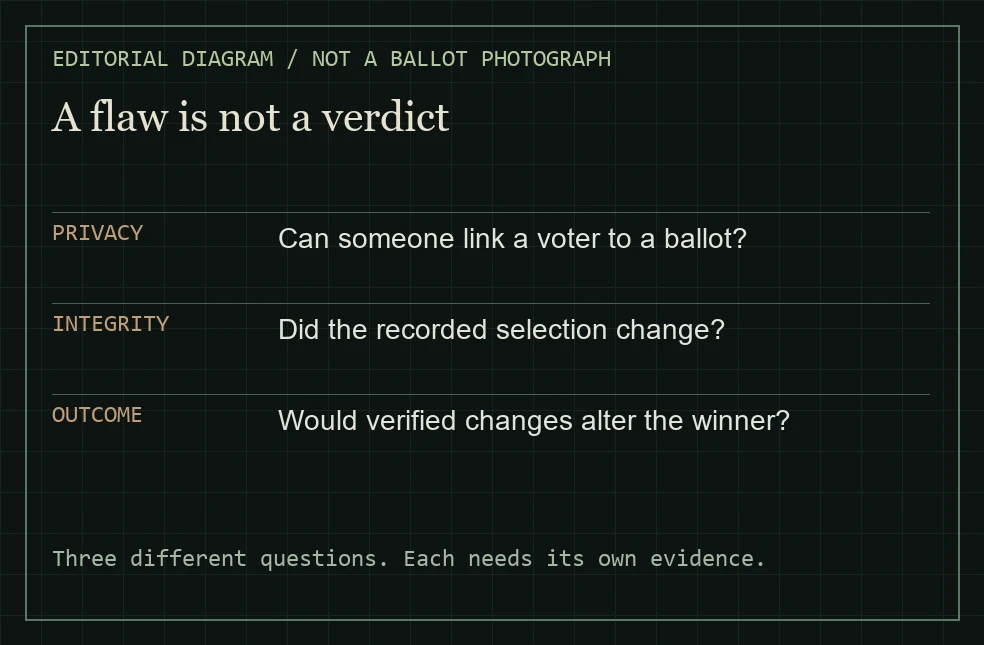 VULNERABILITIES REAL / THEFT UNESTABLISHEDDOSSIER 076
The Rigged Election: Real Flaws, False Claims—and Who Benefits?
The flaw is real. The verdict has to wait for the evidence.