DOSSIER 076 / HISTORY & TRAGEDY
The Rigged Election: Real Flaws, False Claims—and Who Benefits?
The flaw is real. The verdict has to wait for the evidence.
A current Georgia ballot-secrecy dispute is documented. That differs from altered votes. Historical audits rebut specific 2020 claims; reviewed investigations have not established outcome-changing noncitizen voting.
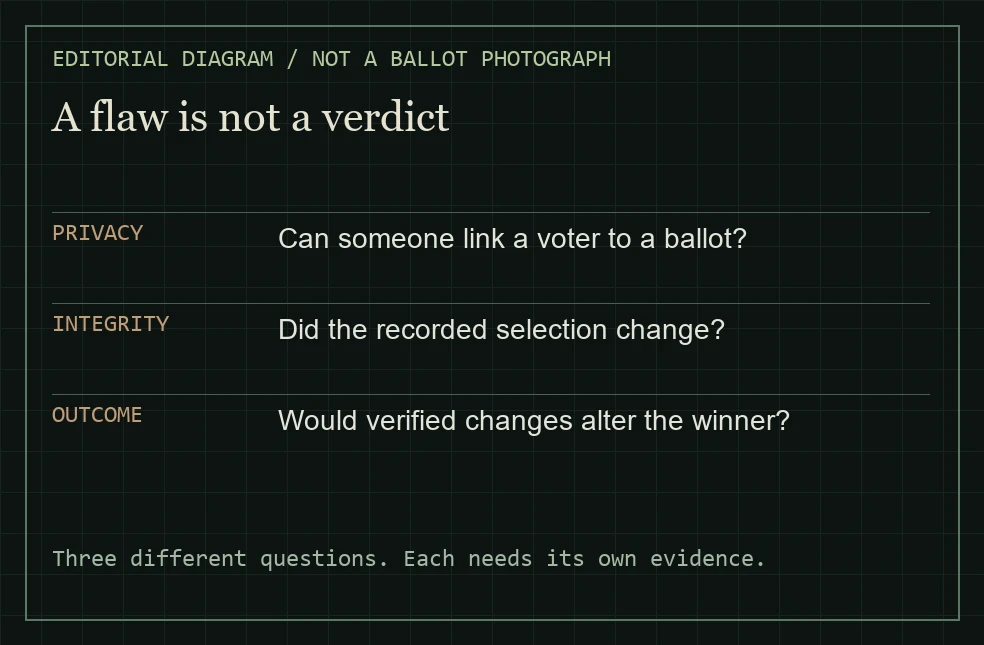
On October 1, 2026, Georgia’s election board adjourned without immediately adopting a proposed response to a ballot-secrecy flaw. Elsewhere, allegations about noncitizen voting continued to circulate ahead of November. Put those stories together carelessly and they become a single announcement: the election is rigged. Read them separately and a more difficult investigation begins. What can go wrong, what has actually happened, and who benefits when the difference disappears?
01 / A real flaw enters a much older story
The Georgia dispute concerns the possibility of linking voters with their cast ballots. AP’s October 1 report describes disagreement over a proposed fix close to the election. Ballot secrecy is a serious requirement. Compromising it would expose how someone voted; it does not automatically mean the recorded vote was changed. The timing and consequences of a software modification are separate questions again.
AP’s same-day reporting on noncitizen-voting investigations says the practice is rare and has not been demonstrated to change election outcomes. That is a different allegation, involving eligibility rather than the software’s treatment of a ballot. Combining these stories under the word fraud erases their mechanisms and evidence.
The broad conspiracy theory says hidden actors can decide the outcome while preserving the outward appearance of voting. It can accuse software vendors, local officials, outsiders, a political party or a federal administration. Those are rival claims, sometimes mutually incompatible. An inquiry cannot quietly switch between them whenever one version loses support.
The archive is examining claims ahead of the November 2026 election. It is not predicting a stolen result before votes have been counted. That temporal boundary matters. Past errors and current vulnerabilities may justify safeguards now. They cannot supply evidence of an outcome that has not yet occurred.
The opening question should therefore be narrow enough to answer: which system, which jurisdiction, which election, which proposed mechanism? Anyone offering a verdict without those particulars is asking the reader to accept a conclusion before the file exists.
02 / The night a video acquired suspects
The Georgia surveillance-video allegations after the 2020 election show what happens when a fragment of observation becomes an accusation. Election workers Ruby Freeman and Wandrea “Shaye” Moss were cast as participants in a covert operation. The House January 6 committee’s report addresses the claims, the surrounding evidence and the attacks that followed. It is a legislative investigation, with testimony and exhibits readers can examine, not a substitute for every separate court proceeding.
Moss testified publicly in June 2022 about harassment and the disruption to her life. TIME’s contemporaneous account describes the experience she and Freeman reported after the allegations circulated. This is firsthand testimony about consequences, presented at a hearing; the archive has not interviewed either woman. Their experience belongs in the file because election conspiracy stories act on identifiable people, not merely on an abstract institution.
The methodological failure is familiar. A viewer sees a container, a gesture or an interruption and supplies the missing context with a theory. A full sequence, an inventory, a procedure or another witness may explain the moment differently. The person alleging wrongdoing then needs to engage that explanation rather than retreat to the proposition that everyone supplying it is involved.
Security footage is evidence of what the camera recorded. It is not a transcript of intention. Even an accurate timestamp can be misleading if the relevant instruction happened outside the frame. This is why provenance and surrounding events are not optional accessories to a viral clip. They are part of understanding the clip.
The lesson is not that observers should stop asking questions. It is that publicly naming a supposed conspirator demands more care than sharing a puzzling image. When the explanation changes, the accusation must change with it. A theory that keeps the person guilty while abandoning its original evidence has ceased to behave like an investigation.
03 / Five million pieces of paper and an inconvenient result
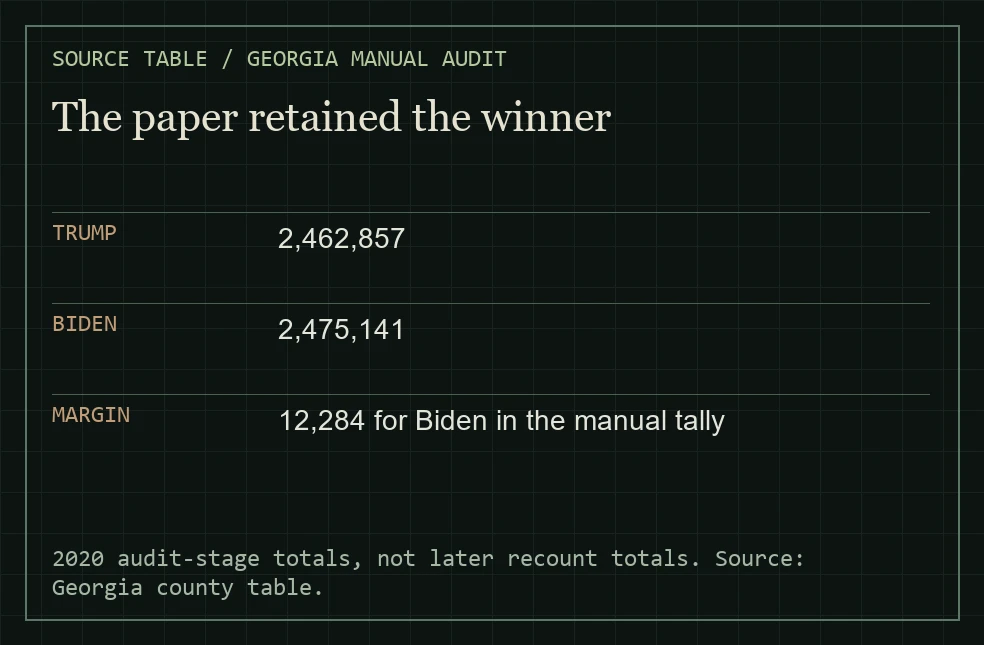
Georgia’s 2020 presidential audit involved a full manual tally because of the close margin. The state’s county-summary table records about five million votes and a Biden lead of 12,284 in that manual tally. The table also shows differences from initial reporting. Those are the audit-stage figures, not a claim that every subsequent recount used identical totals. The reported winner remained Biden.
The existence of discrepancies deserves explanation. It does not follow that every discrepancy was fraud, that it favored the same candidate, or that it was large enough to change the outcome. An audit is meant to expose differences that a single initial count might leave unexamined. Treating a detected error as proof that checking is useless reverses the purpose of the check.
A conspiracy about nationwide software manipulation has to account for the records it predicts. If a particular machine silently changed selections, what would an independent examination of the associated paper show? If it instead changed a printed record before the voter cast it, what opportunity did voters have to review the paper? If it altered a reporting website but not underlying ballots, where should reconciliation reveal the mismatch? These are different failure modes.
This is an analytical set of questions, not a claim that any of those events occurred in Georgia. A testable allegation identifies which mode is supposed to have operated and what evidence would distinguish it from a mistake in reporting. A theory that says the paper, machines, observers and audit are all fabricated requires evidence for each additional layer.
Nor can one successful audit certify every contest in another state or year. The conclusion should stay with the evidence reviewed. The same discipline that prevents a local error from becoming a national conspiracy prevents a local reassuring result from becoming a universal guarantee.
04 / What certification can—and cannot—promise
The Election Assistance Commission publishes certified-system records and oversees a testing framework. Certification concerns specified systems and requirements; it is not a promise that every configuration, local practice or future deployment is flawless. Readers should be able to inspect the actual equipment and version relevant to an allegation rather than rely on a generic claim that a machine was approved.
NIST’s archived auditing material explains the role of voter-verified paper and comparisons with electronic records. An audit’s strength depends on its method and the evidence it examines. A check of original paper, a comparison of stored ballot images and a full recount are not identical activities. Georgia’s 2024 ballot-image report is useful precisely because it describes a particular kind of review rather than being presented here as all-purpose proof of security.
The distinction sounds technical until someone claims that one test settled everything. Ask what was selected, what was compared, who controlled the records and what would trigger escalation. A test may be well designed for one problem and poorly suited to another. A statistical sample may provide strong assurance about the winner without checking every administrative action that occurred during the election.
Believers often respond that a system cannot certify itself. That objection has force when an institution asks for trust without exposing records or allowing meaningful independent checks. It loses force when it refuses to specify what independent evidence would count. If a hand count is dismissed merely because officials supervised it, the alternative needs a coherent way to establish custody and authenticity too.
There is no magical object called a secure machine. There are designs, deployments, procedures, records, checks and people. Their weaknesses should be investigated. Their combined evidence should also be allowed to constrain an allegation.
05 / The illegal-voter claim needs a denominator
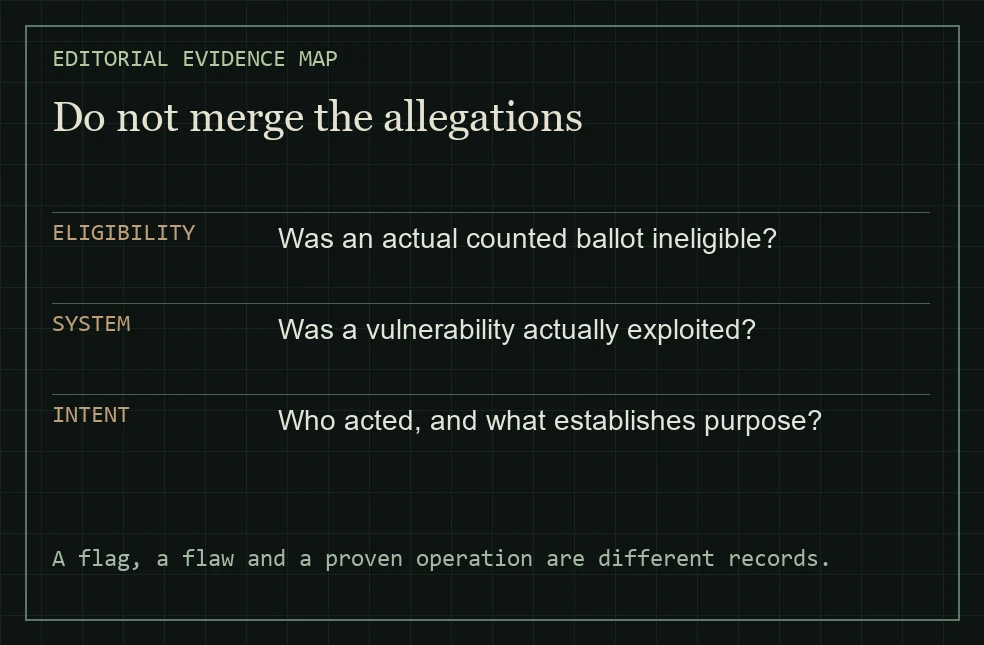
In October 2024, Georgia’s citizenship audit identified twenty noncitizens among 8.2 million registered voters, according to AP. That figure concerns identified registrations in a particular review. It should not be inflated into millions of cast ballots, nor treated as proof that every possible eligibility error had been found. Registration, attempted registration, voting and a counted ineligible ballot are distinct events.
For any later list, ask whether entries were verified, duplicated, corrected or merely flagged for review. Ask when citizenship was assessed relative to registration or voting. Ask whether the records identify an actual ballot and whether investigators determined an offense. A flag is a reason to investigate; it is not a completed investigation.
The denominator changes the interpretation. Ten confirmed instances among a hundred ballots would describe a different problem from ten among ten million. Neither makes wrongdoing acceptable. Both require counting honestly. The electoral significance also depends on the contest’s margin, the affected jurisdiction and whether the evidence establishes how votes were counted.
The nationwide plot adds coordination to the eligibility allegation. That extra claim needs its own evidence: a common organizer, instructions, payments, communication or another demonstrable connection. Similar mistakes in separate places do not automatically reveal a shared director.
AP’s October 2026 reporting supplies a current constraint: the investigations it describes have not shown outcome-changing noncitizen voting. A future verified finding should be assessed on its merits. Presenting a large hypothetical fraud operation as an already established fact is not justified by the possibility that investigators might someday find something larger.
06 / Real interference can target confidence as well as ballots
CISA’s historical mail-in-voting assessment treats infrastructure, procedures and implementation timelines as sources of risk. The document is an archived assessment, not an October 2026 incident report. Its value here is the distinction between identifying a risk and demonstrating an exploit. A rushed change can create a problem without being part of a plot. A precaution can address a risk without admitting that a previous result was stolen.
The wider political process deserves scrutiny too. Cheeseman and Klaas’s comparative work examines ways elections can be compromised through rules, intimidation and manipulated information, alongside ballot fraud. That broader lens should not be used to evade a failed machine allegation. It asks a different question: whether people could participate freely and whether public authority was used properly.
An attempt to undermine confidence may succeed without changing a single recorded vote. A fabricated accusation can frighten workers, discredit a legitimate count or create a pretext to reject an unwanted result. That is an analytical possibility; attributing such an operation to a particular actor still requires evidence of what that actor did. The January 6 committee’s materials offer specific testimony about pressure after 2020, which should be read as a historical record rather than a prediction of identical conduct in 2026.
The two inquiries can coexist. Investigate the count and investigate attempts to interfere with the process. Do not allow one to erase the other. A correct tally does not justify threats against workers. An improper political pressure campaign does not by itself identify which machine, if any, altered a ballot.
This is where the word rigged becomes dangerous to clarity. It can mean an inaccurate count, unfair rules, intimidation, disinformation or an attempt to overturn certification. Each is serious. Naming the alleged act makes it possible to investigate it; leaving the word undefined makes it possible to change the accusation without admitting the change.
07 / When the broadcast becomes part of the evidence
In April 2023, Fox and Dominion reached a settlement exceeding $787 million in their defamation dispute over election-related broadcasts. A settlement is not a jury verdict on damages. It does not establish that every election concern is false. It is a concrete consequence of particular statements and litigation, which readers should distinguish from a general defense of any voting technology.
The media question matters because an allegation can acquire apparent corroboration through repetition. A commentator quotes a post, another program cites the commentator, and the original post returns decorated with the authority of coverage. Three appearances may still be one unverified claim. Count independent evidence rather than the number of places the allegation appeared.
The same applies to testimony. A witness may sincerely describe a troubling observation while being mistaken about its significance. Several witnesses may have seen the same event through different windows. Their accounts should be compared for timing, access and consistency, not merely collected until the pile looks persuasive.
Ask what a source could actually know. A worker at one table may describe that table’s procedure. A software analyst may explain a potential vulnerability. A candidate may describe what supporters reported. None automatically has firsthand access to a nationwide conspiracy. Expertise and access are specific, not portable titles that establish every claim.
The archive’s narration should retain these limits even in a sixty-second video. A compelling hook can open the question. It cannot quietly answer it before the sources arrive. Otherwise the promotion becomes another item that a future investigation has to untangle.
08 / What would change this file after November?
Evidence capable of changing the assessment would connect a mechanism to an actual event: authenticated records of unauthorized changes, properly documented discrepancies, credible insider testimony with corroboration, or a finding that identifies deliberate conduct. Its electoral impact would then require a separate analysis. A confirmed offense can matter even when it did not change the winner.
The strongest skeptical position is not that elections never contain errors. It is that the scale and intent alleged must be established, and that independent checks can rebut particular claims. The strongest believer’s position is not an endless montage of suspicious moments. It is a precise allegation with records that survive those checks.
For a new claim, preserve the original statement and its date. Identify the jurisdiction and alleged act. Locate the full record rather than a cropped clip. Compare the response and ask what evidence supports it. If an explanation resolves the anomaly, acknowledge the resolution. If it does not, specify the remaining gap. These are reading practices, not instructions to interfere with voting equipment or people.
As of this file’s October 5 review, the broad claim of a predetermined or secretly stolen November 2026 result is unestablished. The documented privacy dispute is serious on its own terms. The historical audits and testimony are relevant to how allegations should be tested, not a verdict issued in advance.
An election should not have to be perfect to be checkable. An allegation should not have to be popular to receive scrutiny. What neither side gets is permission to decide first and convert every later record into scenery. The count, the witnesses and the paper trail deserve better than that.
QUESTIONS LEFT ON THE DESK
The questions readers bring.
FAQ & search review: 2026-10-05 · Source links identify the record behind each answer. This date does not certify a new investigation of every chapter.
Does Georgia’s ballot-secrecy flaw prove votes were changed?
No. The reported risk concerns linking voters with ballots. Vote alteration is a different claim requiring evidence of an actual event and its effect.
Did Georgia’s 2020 manual audit change the winner?
No. The state’s manual-tally table retained a Biden lead. Audit-stage differences should not be confused with a reversal of the outcome or identical totals in every subsequent recount.
Has the November 2026 election been shown to be stolen?
This October 5 file does not issue a verdict before that election. Current concerns must be assessed as specific claims, with actual evidence, rather than proof of a result that has not occurred.
Compare the records: The Political Deepfake: Who Said Those Words? · Watergate · The Bot Swarm: Is the Internet Empty?.
The allegation, in brief
A coordinated hidden operation has predetermined the November 2026 election through voting machines or mass illegal voting.
Where the archive stands
A current Georgia ballot-secrecy dispute is documented. That differs from altered votes. Historical audits rebut specific 2020 claims; reviewed investigations have not established outcome-changing noncitizen voting.
A vulnerability is a reason to investigate. It is not a stolen-election verdict.
ARCHIVIST’S NOTE / EXPANDED RESEARCH: 05 OCT 2026
THE SHELF BEHIND THE FILE
For further reading
One carefully chosen book for this file. Read the longer account beside the original records.
As an Amazon Associate I earn from qualifying purchases. Purchases through these links may earn this archive a commission.
- THE WATCHER’S
FAVORITE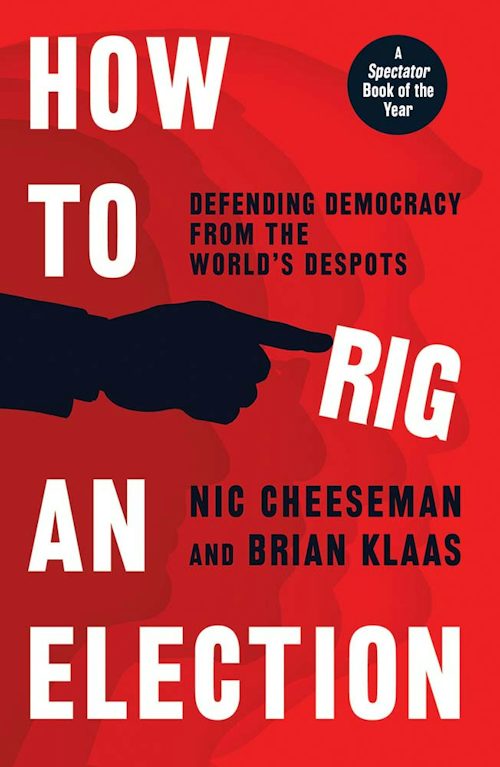 01 / Comparative political research
How to Rig an Election
A comparative account of electoral manipulation; context, not proof of a specific US allegation.
View book on AmazonBook & source detailsWhy this pick?
Selected for topic relevance, reported source material and the published reviews linked in the book details. This is an editorial favorite, not an Amazon-rating claim.
The stamp is an editorial recommendation informed by published reviews, source quality, and relevance. It is not a claim about the highest Amazon customer rating. Selection source.
A place on this shelf is not a verdict on every claim inside. Selection checked 5 October 2026. Cover artwork belongs to its respective rights holders; cover sources & editions. Links open a specific edition. Cover artwork may show a different edition; check the format, availability, and price on Amazon before buying.
A QUESTION LEFT IN THE MARGIN / EDITORIAL PROMPT
Bring one source.
Who gains when a real security flaw becomes a stolen-election verdict before the votes are counted? Name the evidence that would change your mind.
A useful first note: the source, what it establishes, and what it leaves open.
FOLLOW ANOTHER THREAD
Follow this thread.
Compare documented misconduct, disputed explanations and the evidence needed to establish intent.
 DISPUTE IN PROGRESSDOSSIER 073 / FICTIONAL ART
The Political Deepfake: Who Said Those Words?
A familiar face. An invented performance. A two-page demand.
 DocumentedDOSSIER 052
Watergate
A break-in became a presidency’s undoing.
 TAKEOVER UNPROVENDOSSIER 072 / FICTIONAL ART
The Bot Swarm: Is the Internet Empty?
The traffic is real. The people-count is another question.