DOSSIER 068 / SPECIAL EDITION: KOREA
Cheonan: collision and cover-up claims
A warship split in darkness. The argument survived the salvage.
The official torpedo finding has faced technical criticism. A concealed collision or fabricated attack has not been established.
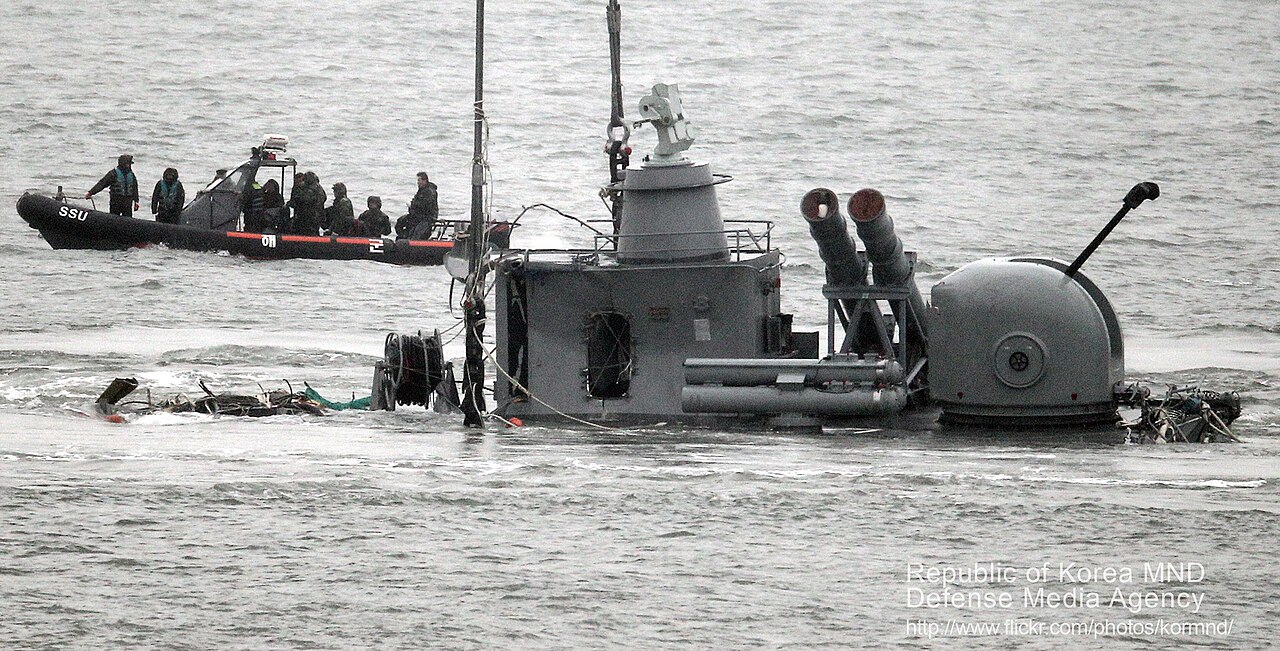
The captain was told that the stern had disappeared. For the men still on the bow, the first question was whom they could pull out. Investigators would later argue over a torpedo, a handwritten marking, and the sound a submarine might make. The sailors had already lived through the part nobody disputed.
01 / What the men on the bow remembered
Cheonan was on patrol near Baengnyeong Island on the night of 26 March 2010. At their first public press conference on 7 April, survivors said the ship had been operating normally before the sudden blast. Some described two explosive sounds and a violent roll to starboard. Some had not seen a water column. The Korea Times recorded those differences before the final inquiry had announced a cause. Fifty-eight of the 104 aboard survived. A press conference could preserve their observations; it could not retrospectively give everyone the same vantage point.
In an April telephone interview with the JoongAng Ilbo, Commander Choi Won-il recalled a crying sailor reporting that the rear of the ship was gone. His immediate concern was rescuing men unable to escape from the bow. It is firsthand testimony about a broken ship and decisions under pressure. The leap from what a sailor heard or failed to see to the identity of a weapon needs other evidence. Darkness, position, and the suddenness of the event belong in any reading of these accounts. They must not be edited out to make a witness fit a theory.
02 / The torpedo on the table
The Joint Investigation Group’s official case centered on a powerful underwater explosion. It cited upward deformation of the hull, pressure effects, and recovered propulsion components that investigators connected to a North Korean torpedo design. The report also drew on explosive and seismic analysis. Its argument was cumulative: the weapon attribution was meant to follow from several strands, rather than from the blue handwritten marking alone. The defence ministry organized the inquiry with Korean civilian and military personnel and foreign experts. Its report remains the principal official account, and an institution’s explanation of its own investigation.
S.-H. Lee and P. Yang challenged the advertised scientific proof in a June 2010 preprint. They questioned whether the reported spectroscopy and X-ray results for material from the ship, torpedo, and test explosion supported the proposed comparison. Their title explicitly raised fabrication. This was a technical accusation requiring technical answers, not merely a refusal to trust Seoul. But an arXiv manuscript is not an independent finding that evidence was planted. Even a demonstrated flaw in one comparison would still leave the other physical evidence to be assessed on its own merits.
03 / A submarine appears in the calculations
Hwang Su Kim and Mauro Caresta offered a different mechanism in a paper published in November 2014. They examined seismic spectra, arguing that prominent frequencies and harmonics were inconsistent with the water-column explanation they criticized. Their models related those frequencies to vibrations of a large submarine, around 113 metres long. They proposed collision as a possibility. This is a published physical argument with equations and assumptions available for inspection; it deserves a more serious reading than an unexplained claim about a mysterious ship.
Its conclusion still needs to be kept inside its boundaries. Matching a modeled structure to selected acoustic features does not document a particular submarine at the scene. It does not produce a collision log, identify a crew, or demonstrate that torpedo components were planted afterward. A stronger collision case would have to explain the whole damage pattern and evidence trail, not only the frequency pattern. A cover-up case would then need evidence of concealment and coordination. The appeal of a submarine in the equations is understandable. The missing step is finding that submarine in the history.
04 / The inquiry that would not stay closed
People’s Solidarity for Participatory Democracy published its own list of objections in June 2010. It complained about disclosure, changing accounts of recordings, limits on civilian participation, and measures against people raising doubts. These are the civic group’s accusations about investigative process. Transparency matters because an explanation tested only by its authors is harder for outsiders to audit. Yet restricted access alone cannot identify which alternative account is true. Secrecy can obstruct verification without functioning as a confession to the reader’s preferred scenario.
The dispute returned in 2021 when a presidential commission accepted a petition from former investigator Shin Sang-cheol seeking renewed scrutiny. Yonhap reported that the decision was retracted after objections from bereaved relatives and survivors. Those objections are part of the human record too: reopening a question can look like overdue accountability to one person and another challenge to the dead’s history to another. This archive leaves the scientific arguments accessible, with their authors attached. It does not ask the reader to choose a political camp before reading them, or treat the existence of controversy as proof that a conspiracy succeeded.
The allegation, in brief
Alternative accounts propose a submarine collision or manipulated evidence behind Cheonan’s sinking, rather than the officially identified North Korean torpedo attack. Technical criticism, an alternative physical mechanism, and a deliberate scheme to frame another country are separate claims.
Where the archive stands
The official multinational inquiry attributed the sinking and 46 deaths to a North Korean torpedo. Its case combined hull damage, explosion analysis, and recovered components. Critics challenged materials analysis and access to evidence; a 2014 paper modeled a possible submarine collision. Those critiques do not independently establish a hidden vessel or a coordinated fabrication. The label applies to the cover-up allegation, while the file preserves the substantive technical dispute.
A model can describe a submarine. It cannot tell you who sailed it, where it went, or who ordered the silence.
ARCHIVIST’S NOTE / EXPANDED RESEARCH: 02 OCT 2026
THE SHELF BEHIND THE FILE
For further reading
A shelf for the divided peninsula and its political history. These contextual books are not substitutes for the naval reports and scientific papers above.
As an Amazon Associate I earn from qualifying purchases. Purchases through these links may earn this archive a commission.
- THE WATCHER’S
FAVORITE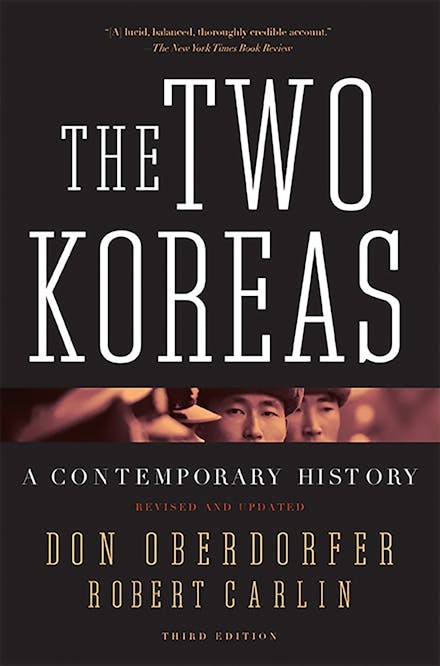 01 / Diplomatic history
The Two Koreas: A Contemporary History
Choose the revised 2013 edition for the context of the divided peninsula. A broad diplomatic history, not a forensic verdict on Cheonan.
Find editions on AmazonBook & source detailsWhy this pick?
Selected as a major specialist diplomatic history. The Korea Society presented the revised edition with Robert Carlin, describing its standing in modern Korean history. It supplies context rather than endorsing a conspiracy.
The stamp is an editorial recommendation informed by published reviews, source quality, and relevance. It is not a claim about the highest Amazon customer rating. Selection source.
 02 / History / reportage
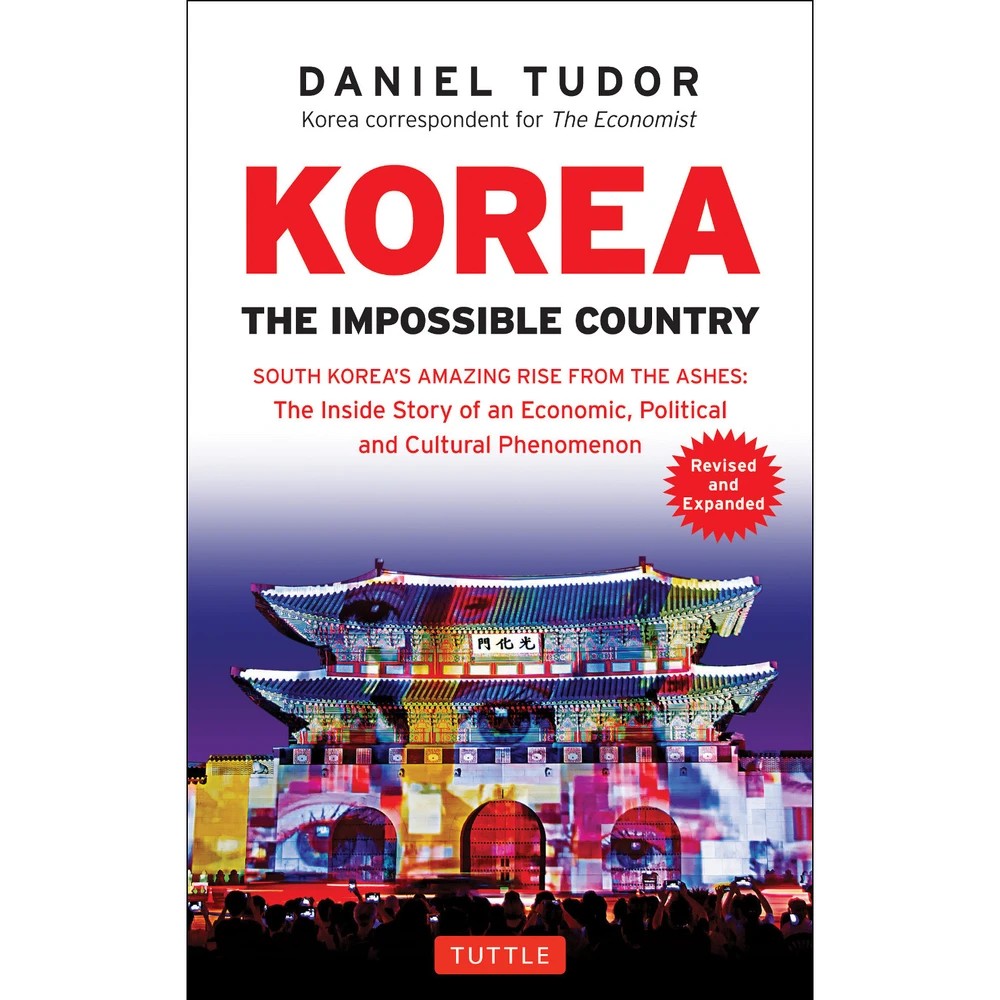
Korea: The Impossible Country
Choose the updated edition: it includes Sewol and Park’s impeachment, alongside the political and cultural setting of modern South Korea.
Find editions on AmazonBook & source details
A place on this shelf is not a verdict on every claim inside. Selection checked 2 October 2026. Cover artwork belongs to its respective rights holders; cover sources & editions. Covers identify a selected edition; Amazon lists current editions, availability, and prices.
A QUESTION LEFT IN THE MARGIN / EDITORIAL PROMPT
Bring one source.
Which disputed physical finding is most consequential? Compare the original report with the criticism of that finding.
A useful first note: the source, what it establishes, and what it leaves open.
FOLLOW ANOTHER THREAD
Adjacent files
 COLLISION UNPROVENDOSSIER 067
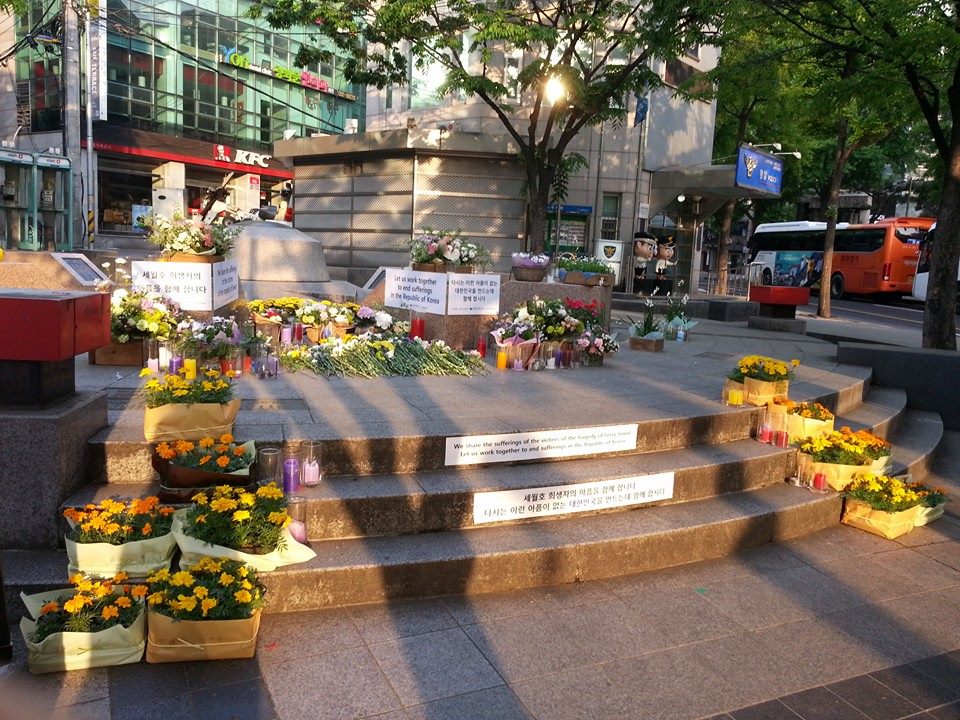
Sewol: the submarine beneath the story
The children were told to wait. Years later, a radar trace became an accusation.
 INFILTRATION CLAIM REFUTEDDOSSIER 069
Gwangju: the invented infiltrators
The witnesses asked the world to look. Another story tried to change who they were.
 OCCULT CABAL UNPROVENDOSSIER 070
Park Geun-hye and the Eight Fairies
An unofficial adviser was real. The shadow cabinet acquired a more elaborate name.