DOSSIER 086 / DIGITAL FOLKLORE
Who Would See a Digital-Euro Payment?
A proposed public currency puts banks, central-bank infrastructure and offline wallets on different sides of the privacy question.
Unresolved concerns the effectiveness of the proposed privacy safeguards in implementation. It does not equate a documentary critique with an observed breach or describe a negotiating text as final law.
On October 17, Christine Lagarde put a date on the next experiment. In a statement to the International Monetary and Financial Committee, the European Central Bank president described a twelve-month internal digital-euro pilot beginning in the second half of 2027. She also named a condition: legislation establishing it would need to be adopted by the end of 2026. That timetable describes preparation for a proposed retail payment system. It does not establish that Europeans already use it, or that a central bank can decide what every person buys. The questions about control begin with the design: who handles a payment, what information reaches each participant, and which powers the governing law actually grants.
01 / The public money behind the app
The European Central Bank describes the proposal as a way to use central-bank money digitally, alongside banknotes and coins. In its August 2026 FAQ, it says cash would continue as legal tender. The project’s stated purpose therefore includes preserving a public means of payment as more purchases move online.
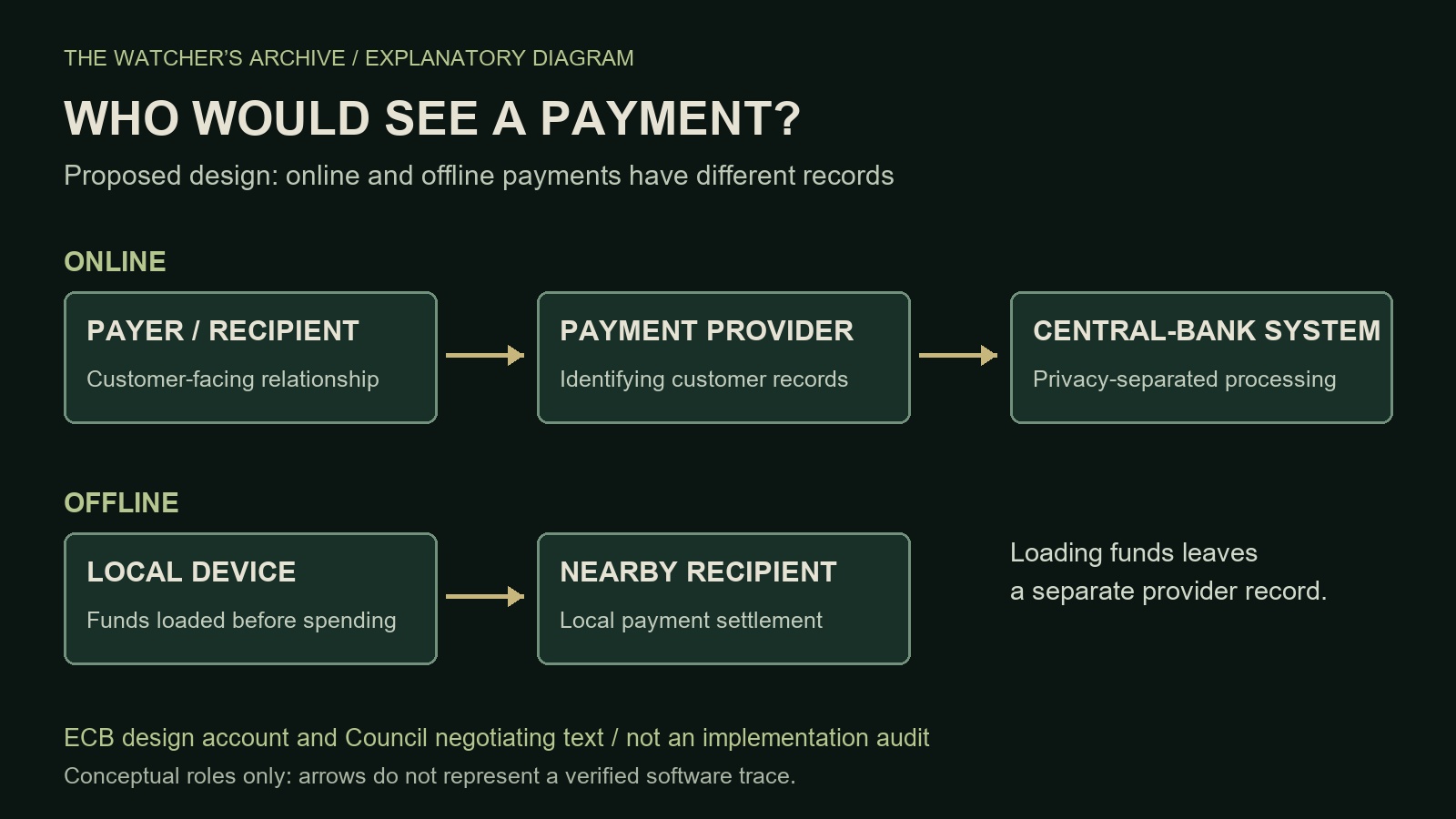
A customer would normally deal with a bank or another supervised payment provider, which would open the digital-euro account and handle customer services. Offline spending would require loading funds first. That division of responsibilities helps explain the privacy dispute: the company serving a customer and the central-bank infrastructure would occupy different positions in the payment chain.
02 / What would be programmed?
The ECB’s FAQ separates restrictions attached to money itself from a condition a customer places on a payment. Its example is paying an online seller after delivery. The bank says its proposed currency would not carry voucher-like restrictions specifying where or when it could be spent. That is the institution’s stated design position, which should be checked against the proposed regulation and eventual implementation.
A payment held until a delivery arrives does not by itself show an authority deciding which products a person may buy. To substantiate the broader spending-control allegation, the investigation would need to identify the restriction, who can impose it and the legal or technical mechanism that enforces it. Whether future rules could change is a further question; speculation about a change cannot establish that the present design already contains it.
03 / A safeguard written into a negotiating text
The Council’s December 2025 negotiating mandate puts the distinction into its operative text: Article 24 permits conditional payments while excluding programmable money. Its offline provisions preserve a different boundary: payment details would not be retained by intermediaries, while records of loading and unloading funds would remain available under specified rules. The text records the Council’s position at that stage of negotiations; it does not establish the wording of an adopted regulation.
The distinction turns on who agrees to the condition and what it governs. In this Council version, the payer and recipient agree when a transfer should happen. Restrictions built into the currency itself, including expiry or permitted purchases, fall within the excluded category. That wording provides a concrete test for examining later proposals and software.
04 / The critics are asking who can reconstruct a life
Joe Cannataci and his coauthors examine the ECB's public documents in a July 2026 revision of their paper, *Digital Euro: Frequently Asked Questions Revisited*. Their privacy argument focuses on online payments and the difference between removing a name and preventing records from being connected. They argue that persistent account identifiers could still reveal spending patterns, and that connecting one transaction to a person could expose more of that person's history. That is their analysis of the proposed architecture, rather than a report of a breach in an operating public currency.
Their paper treats offline payments separately. It questions whether hardware under a user's physical control can reliably prevent copying and double spending, and who would bear losses if it failed. These are different objections from an authority programming a list of permitted purchases. Which criticisms still apply depends on the architecture and document versions ultimately adopted.
The reviewed sections draw on published plans and earlier research. They do not report a successful attack on a deployed digital-euro wallet.
05 / Who would see a payment?
The ECB describes offline payments as known only to the payer and recipient. Online payments would leave a different record: the central-bank system would receive pseudonymised information, while an intermediary such as a bank would hold information needed for legal compliance. These are stated design commitments. They do not establish that a name-free record can never be connected to a person.
France’s data protection authority, the CNIL, describes a specific privacy question in its May 2026 account. It supports safeguards for small online payments and a token-based approach to confidentiality. Its discussion helps locate the dispute in the architecture, rather than assuming privacy concerns necessarily depend on an authority prescribing purchases. The technical design, the law and eventual implementation each need examination.
06 / A pilot is not a law
In an October 6 speech, ECB Executive Board member Piero Cipollone described Parliament’s July negotiating position and talks between Parliament, the Council and the European Commission. These three-way negotiations are known as trilogues. The institutions were still working toward legislation; adopting a negotiating position had not completed that process.
Cipollone said the ECB would decide whether to issue a digital euro after legislation had been adopted. Its aim of being ready for a possible first issuance in 2029 depended on the legislative process concluding by the end of 2026. Lagarde’s October 17 statement described the intervening internal pilot. Those dates set out the institution’s plan rather than announcing a public currency already in use.
The Council’s December 2025 mandate, the ECB’s August FAQ and the July criticism capture different stages of the project. Together they identify questions the eventual rules and software will have to answer: which records can be linked, who can access them, and how offline funds are protected. They do not establish the final compromise or demonstrate the privacy of an operating public system.
The allegation, in brief
The proposed digital euro can provide online and offline payments while protecting users’ transaction privacy.
Where the archive stands
The ECB describes different online and offline safeguards. Named researchers question linkability and offline security; the reviewed institutional plans and negotiating texts do not establish the privacy of a deployed public system.
The useful evidence is the information each participant receives and the powers the operative rules actually grant.
ARCHIVIST’S NOTE / EXPANDED RESEARCH: 25 OCT 2026
THE SHELF BEHIND THE FILE
For further reading
Take the longer trail. These are the books we would keep beside this file.
As an Amazon Associate I earn from qualifying purchases. Purchases through these links may earn this archive a commission.
- THE WATCHER’S
FAVORITE 01 / Personal data, corporate collection and government surveillance
Data and Goliath: The Hidden Battles to Collect Your Data and Control Your World
Background on data collection and surveillance; published before the current disputes.
View book on AmazonBook & source detailsWhy this pick?
Selected for relevant background; publisher, author bibliography, Amazon paperback and matching publisher cover verified. No customer-rating comparison is claimed.
The stamp is an editorial recommendation informed by published reviews, source quality, and relevance. It is not a claim about the highest Amazon customer rating. Selection source.
A place on this shelf is not a verdict on every claim inside. Selection checked 2 October 2026. Cover artwork belongs to its respective rights holders; cover sources & editions. Links open a specific edition. Cover artwork may show a different edition; check the format, availability, and price on Amazon before buying.
A QUESTION LEFT IN THE MARGIN / EDITORIAL PROMPT
Bring one source.
Which privacy safeguard would matter most in a digital-euro payment: keeping transaction records apart, limiting who can identify a payer, or making offline payments practical? Explain the evidence behind your choice.
A useful first note: the source, what it establishes, and what it leaves open.
FOLLOW ANOTHER THREAD
Follow this thread.
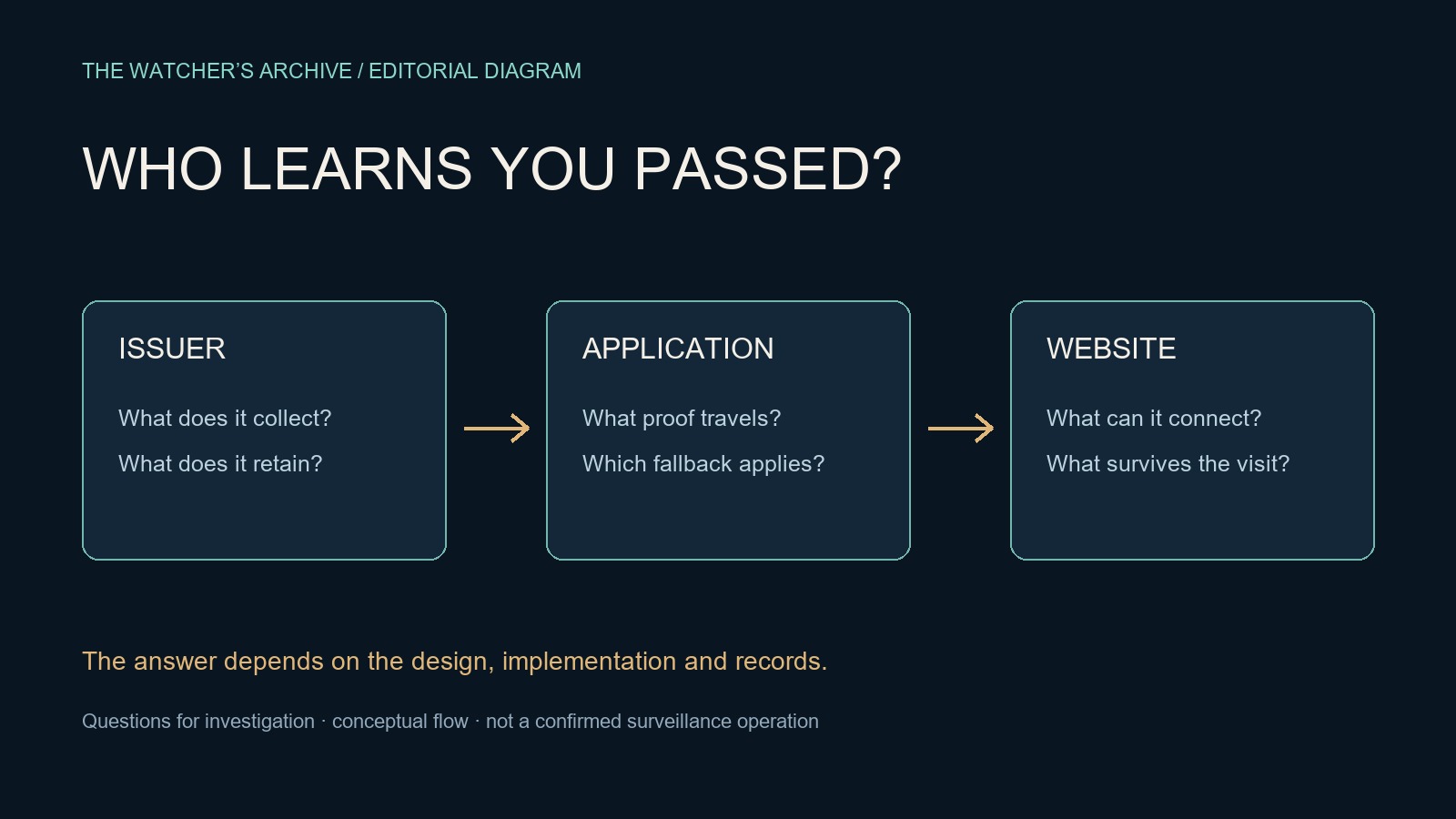
Compare what an intermediary learns in payment and age-verification systems.
 PRIVACY RISKS DOCUMENTED / COORDINATED PLAN UNPROVEDDOSSIER 085
Who Gets to Know You Passed the Age Check?
A Roblox shareholder complaint and a European privacy dispute reveal different questions behind the internet’s new gates.
 DocumentedDOSSIER 058
Project SHAMROCK: thirty years of secret telegram collection
How a wartime arrangement outlived the war—and put Americans’ messages in government hands.
DocumentedDOSSIER 054NSA bulk telephone records
The surveillance story had a paper trail.