DOSSIER 085 / DIGITAL FOLKLORE
Who Gets to Know You Passed the Age Check?
A Roblox shareholder complaint and a European privacy dispute reveal different questions behind the internet’s new gates.
Unsupported concerns the coordinated-plan claim. It does not dismiss documented technical limitations or the risk of excluding adults.
At 3:16 p.m. on October 20, a shareholder’s complaint entered the Clark County District Court in Nevada. Daniel Colbert sued Roblox’s officers and directors on the company’s behalf, alleging that they misled investors about how age checks and communication restrictions would affect its business. The filing placed a practical consequence of age verification before a court: what happens when a platform makes parts of its social life conditional on passing a check?
01 / An age check reaches the courthouse
Colbert’s account remains an allegation. The complaint concerns corporate disclosures and duties; it does not establish a government surveillance scheme. It offers a contemporary starting point for a broader question about online gates, while the European blueprint raises a separate dispute over what those gates can learn about people.
02 / What a platform already told its investors
Roblox’s first-quarter 2026 shareholder letter supplies a company account of the trade-off. It attributed slower acquisition and weaker communication to its age-check rollout, while arguing that the changes would improve safety and longer-term growth. It described checks as a condition for text and voice chat, and said its developing system also used signals such as play history, social connections and economic activity.
That account concerns one company’s product. It does not establish how the EU blueprint works or answer the allegations in the newly reported shareholder lawsuit. It does show why an investigation needs to examine what an age check controls, the information it uses and the consequences of refusing it, rather than treating every check as the same transaction.
03 / Three questions hidden inside an age check
The disputes concern different stages of a decision. First, how does a provider decide whether someone is old enough? Then, what does it tell the service the person wants to use? Finally, what happens to the information afterwards? A system that estimates an age from an image and one that accepts a credential can place different demands on a visitor. Neither label tells a reader everything about retention or linkage.
The Roblox documents describe a platform changing access to communication and content. The European technical profile describes how a proof can travel between participants. Keeping those settings separate makes the comparison useful: one shows the consequences of a gate in an operating product, while the other exposes choices in a proposed shared design. Neither supplies evidence that all age checks belong to a single coordinated system.
04 / The European proposal
The European Commission’s proposal arrived on 17 September with a promise to make the internet safer for children and a practical problem for the services covered by it: how would they establish someone’s age? The proposal’s opening explanation describes a patchwork of national approaches and argues for a common framework. Its technical choices deserve examination because the person asking to enter a service may care as much about who learns of the visit as about whether the check succeeds.
This remains a legislative proposal. A Commission announcement that it adopted a proposal does not mean Parliament and Council have enacted the regulation. The announcement describes the Commission’s position; the later legislative decisions and the software people actually use remain separate parts of the story.
05 / The person who cannot pass the check
The Electronic Frontier Foundation’s October account asks what happens when an adult has no identity document accepted by a service. In that situation, a check intended to keep children out can also exclude someone who meets the age requirement. The organization argues that policymakers have paid too little attention to this access problem. Its account is advocacy against age-gating, rather than an independent test of every verification product.
That concern gives the investigation a concrete task: establish which methods a particular service accepts, whether an alternative exists and what happens when a legitimate user is rejected. A policy built around documents can exclude differently from a system that estimates age. Neither outcome should be assumed from the phrase age assurance alone. No rejected user has been interviewed for this file.
06 / A credential can leave a trail
European Digital Rights offered a more specific technical objection in September. Its analysis argued that issuing batches of separate age credentials could reduce tracking between websites while still leaving information that an issuer and a website might connect. The organization also questioned whether stronger cryptographic protections were mandatory and whether restrictions on keeping records were strong enough.
This is a rights group’s critique of published specifications. Its description must be read alongside the newer technical profile, which changes the requirements for cryptographic proofs. A service’s ability to link records, the decision to keep them and evidence that someone used them for surveillance are separate questions. The critique identifies mechanisms worth investigating; it does not document a universal secret browsing-history database.
07 / The Commission’s promise
The Commission describes its solution as a way to establish an age threshold without giving a website the rest of a person’s identifying information. Its policy page traces the blueprint to July 2025 and says the solution became feature-ready in April 2026. It also describes independent scrutiny and a planned trust framework for providers. Those are institutional claims and planned governance measures; the page alone cannot show how every national implementation behaves.
This gives the two sides a specific point of disagreement. The Commission says the design protects privacy, while EDRi questions whether the specifications require enough separation and prevent enough linkage. The current technical profile helps identify the remaining disagreement, although independent testing of actual implementations is still missing from the evidence reviewed here. Treating all age checks as copies of one deployed system would obscure the differences that matter most.
08 / The fallback matters
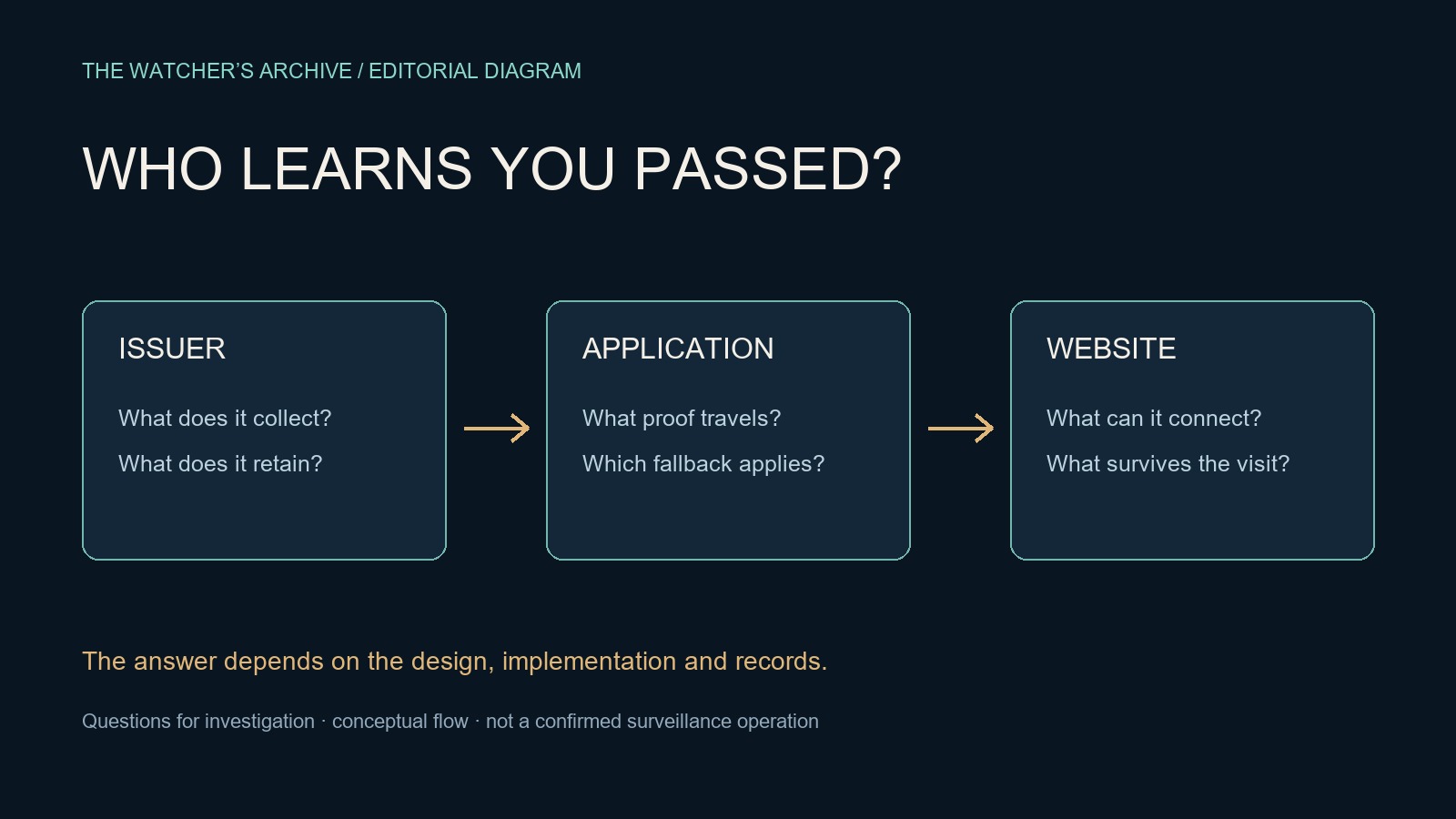
The current technical profile makes the dispute more specific. A credential is a digital statement about its holder; an issuer supplies it and a verifier, such as a website, checks it. A zero-knowledge proof lets the holder demonstrate an age threshold without disclosing the underlying identifying details. Section A.8 requires proof generation when a device supports it.
The profile also retains a plain digital-document fallback, called mDoc, for unsupported devices or an alternative exchange protocol called OpenID. Section A.9 acknowledges that this fallback lacks the same protection against connecting separate presentations. A website cannot distinguish an unsupported device from a presentation downgraded to the fallback. Batch issuance and single-use rules aim to reduce that risk. Some features remain unimplemented, so the specification cannot establish every service’s behavior. EDRi’s earlier description of optional proofs needs to be read against this newer requirement; fallback privacy remains a concern in the current document itself.
09 / What would establish a surveillance claim?
A website learning that a visitor meets an age threshold does not, by itself, explain whether that visitor can be identified elsewhere. The relevant evidence would follow the transaction through each participant: the organization issuing the credential, the application carrying it and the service checking it. An investigation would need to establish which identifiers each participant receives, which records survive and whether those records can be connected. Access logs, retention policies, contracts and independent testing would help answer different parts of that question.
There are also two distinct ways a system can fail its users. A design may allow records to be linked, even without evidence that anyone has done so. Separately, people may lose access because they cannot obtain or use an accepted credential. A privacy audit cannot settle the access question on its own. Both deserve scrutiny, especially before a system becomes a routine condition of reading, speaking or joining a community online.
For the broader theory of a coordinated plan to end anonymity, the evidence would have to go further still: documents establishing intent, responsible decision-makers and the connection between their decisions and the alleged outcome. The material reviewed for this file does not establish that chain. The documented fallback limitations are a concrete place to investigate without pretending the larger accusation has already been proved.
The allegation, in brief
Age checks are part of a coordinated plan to end anonymity online.
Where the archive stands
A shareholder complaint, company disclosures and technical specifications document separate disputes over access and privacy. They do not establish a coordinated surveillance plan.
The useful trail runs through what each participant receives, retains and can connect.
ARCHIVIST’S NOTE / EXPANDED RESEARCH: 23 OCT 2026
THE SHELF BEHIND THE FILE
For further reading
This 2016 paperback provides background on data collection. It does not establish the current allegations or assess this age-verification implementation.
As an Amazon Associate I earn from qualifying purchases. Purchases through these links may earn this archive a commission.
- THE WATCHER’S
FAVORITE 01 / Personal data, corporate collection and government surveillance
Data and Goliath: The Hidden Battles to Collect Your Data and Control Your World
Background on data collection and surveillance; published before the current disputes.
View book on AmazonBook & source detailsWhy this pick?
Selected for relevant background; publisher, author bibliography, Amazon paperback and matching publisher cover verified. No customer-rating comparison is claimed.
The stamp is an editorial recommendation informed by published reviews, source quality, and relevance. It is not a claim about the highest Amazon customer rating. Selection source.
A place on this shelf is not a verdict on every claim inside. Selection checked 2 October 2026. Cover artwork belongs to its respective rights holders; cover sources & editions. Links open a specific edition. Cover artwork may show a different edition; check the format, availability, and price on Amazon before buying.
A QUESTION LEFT IN THE MARGIN / EDITORIAL PROMPT
Bring one source.
What would you need to know about an age-check provider before trusting it: which information it receives, how long it keeps records, or what happens if it rejects you? Which published policy or technical finding would change your answer?
A useful first note: the source, what it establishes, and what it leaves open.
FOLLOW ANOTHER THREAD
Follow this thread.
Compare a documented historical collection program with a contemporary claim requiring its own evidence.
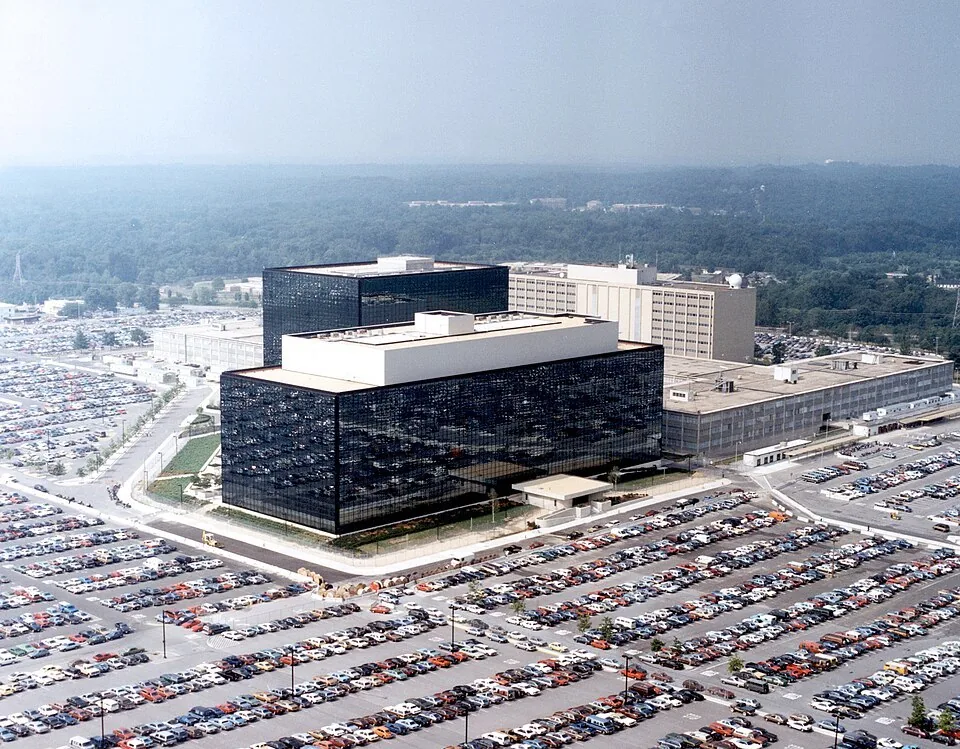 DocumentedDOSSIER 058
Project SHAMROCK: thirty years of secret telegram collection
How a wartime arrangement outlived the war—and put Americans’ messages in government hands.
 TAKEOVER UNPROVENDOSSIER 072 / FICTIONAL ART
The Bot Swarm: Is the Internet Empty?
The traffic is real. The people-count is another question.
 DISPUTE IN PROGRESSDOSSIER 073 / FICTIONAL ART
The Political Deepfake: Who Said Those Words?
A familiar face. An invented performance. A two-page demand.