DOSSIER 081 / CULTURE & BELIEF
Andrew Gallimore’s DMT Theory: Is the Brain Building Alien Worlds—or Receiving Them?
He couldn’t forget the encounter. He wanted enough time to understand it.
Unresolved concerns the external-world interpretation. This profile does not allege a covert operation by Gallimore or equate his speculative writing with established experimental results.
THE RECORD, IN BRIEF
What does Andrew Gallimore argue about DMT?
Gallimore explores how DMT changes the brain’s experienced world and considers whether encounters could involve independent intelligences. His research proposal for prolonged experiences is distinct from that unverified external-world interpretation.
Andrew Gallimore remembers lying on his bed, shaking. He had just taken DMT and felt he had encountered an intelligence whose existence had never occurred to him. Writing about it in February 2023, years after the experience, he recalled being unable to put what he had seen behind him. He would spend much of his life trying to understand it. There is something familiar about that beginning: someone sees something they cannot explain, and the explanation they eventually find changes how other people look at the world.
01 / The encounter he couldn’t leave alone
Before his own experience, Gallimore had listened to Terence McKenna and read about DMT on the early internet. McKenna supplied an exuberant vocabulary for the places and beings people said they encountered. Gallimore’s later account describes an experience that still caught him unprepared. We have his recollection, written afterward, and the work that followed. We have no independent record of the intelligence he believed he met.
His official biography describes him as a neurobiologist, chemist, pharmacologist and writer based in Tokyo. On the 2016 infusion paper, his affiliation was the Okinawa Institute of Science and Technology. The date matters here; an old paper’s address does not tell us where someone works today. His training helps explain why he approached the experience through questions about molecules, information and the brain.
For this archive, the interesting story is what happened after the encounter. Gallimore developed a model, wrote papers and books, and gave readers a way to think about experiences that are notoriously difficult to describe. Follow that process and you can watch a private conviction become a public argument. The file belongs beside our accounts of machine elves and extended DMT because it explains one influential interpretation of them.
His work also gives us something more substantial to examine than an anonymous trip report. We can read what he proposed, check what a study actually measured, and see where he asks the reader to follow him beyond those measurements. I want to give the argument that attention before deciding how much of it I believe.
02 / “Trying to show me something”
In a 2021 study by Pascal Michael, David Luke and Oliver Robinson, a participant identified as TM described mechanical, clown-like figures presenting objects that kept changing. Recalling his second session in the study, he said they were “trying to show me something”. The researchers recorded his account. They could not watch the figures themselves.
That small detail—the apparent wish to show someone an object—helps explain the fascination. An encounter can seem to have a purpose. The other presence appears to direct attention, to do something unexpected, to carry on with business of its own. For a person remembering it afterward, the impression of another mind may be harder to dismiss than the unusual shapes or colors.
The researchers analyzed 36 experiences, with apparently sentient encounters reported in 34. Their participants were selected, experienced users who supplied their own material; its identity and purity were not analytically verified. Those conditions limit how widely we can apply the findings. The paper gives us detailed accounts from this group, rather than a reliable forecast of what any given person would experience.
Davis and colleagues took a different approach in 2020, surveying 2,561 people who had reported a DMT entity encounter. Many described communication, lasting effects and an experience they interpreted as more than hallucination. Recruitment began with people who already had such an encounter, and respondents described their most memorable one. The survey therefore tells us about these remembered encounters and their meaning to the respondents. It leaves the source of the apparent intelligence open.
Reading these accounts, I keep coming back to the same difficulty: someone can be honest, precise and deeply affected by what happened, while the explanation remains uncertain. We need to understand how that sense of another mind arises. The testimony gives us a place to start.
03 / What Gallimore means by a reality switch
Gallimore’s 2023 explanation starts with a world built by the brain: the surroundings we experience from moment to moment. Psychedelics, in his account, change the neural patterns through which that world takes shape. His “reality channel” language describes how a drug can replace familiar experience with something almost unrecognizable. At this level, the subject is perception.
His 2015 theoretical paper approached psychedelic consciousness through integrated information theory, exploring relationships between brain organization and the qualities of experience. It is a framework for thinking about the problem. Readers looking for a completed explanation of consciousness, or an experiment that detected an outside intelligence, will not find one there.
His 2020 essay on DMT entities ventures further. He considers intelligences beyond ordinary reality, including advanced beings that might have outgrown biological bodies. He also describes Alien Information Theory as a vision he has developed, acknowledging its speculative character. That is helpful guidance from the author himself when reading the more confident passages of his work.
The difficult step is explaining where the information comes from. A brain capable of constructing an unfamiliar scene could account for part of the experience. Gallimore asks us to consider whether some of what it constructs might come from elsewhere. If so, what carries it? What would show that the brain received information it could not have generated or acquired ordinarily?
I can understand the appeal. His approach gives the beings a place in the discussion and asks why the encounters seem so organized. It also leaves him with a demanding burden: finding a way to investigate their apparent independence. The descriptions make that question compelling. They have not yet answered it.
04 / 2016: a proposal to stay longer
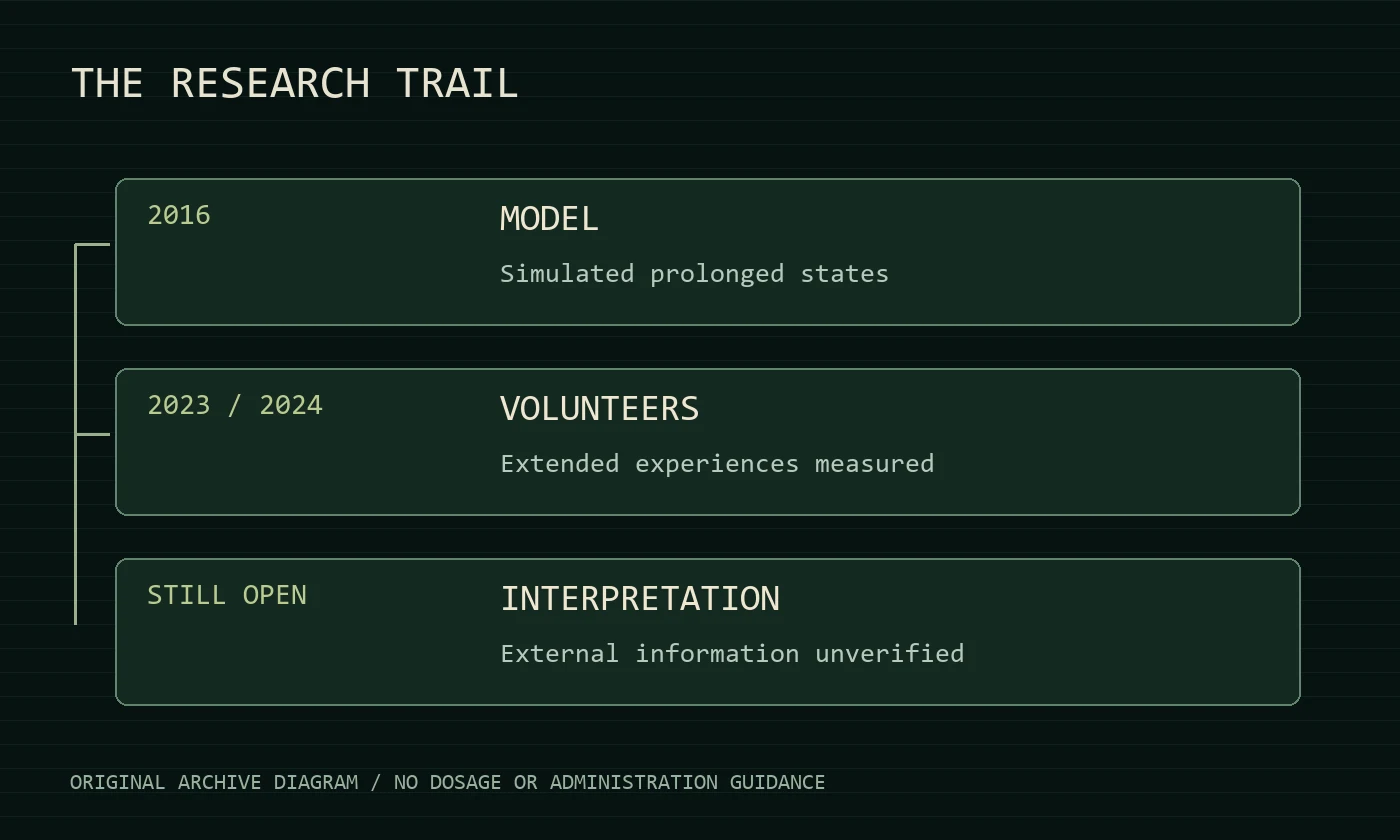
In July 2016, Gallimore and psychiatrist Rick Strassman published a pharmacokinetic model for maintaining a prolonged DMT experience through target-controlled intravenous infusion. Using existing blood-sampling data and simulations, they proposed how researchers might sustain the state long enough to study it carefully. The paper’s results were simulations; human testing would have to follow.
Later, Luan and colleagues studied extended administration in 11 healthy volunteers. Imperial’s November 2023 account described effects maintained over 30 minutes, with generally low anxiety among those selected volunteers under supervision. The paper appeared online in 2023 and in a 2024 journal issue. Both dates refer to the same study.
More time could make a practical difference. Researchers might repeat a task, take several measurements or ask for an account while the experience is still unfolding. Someone who reports returning to a particular place might have longer to describe what makes it recognizable. These are opportunities for investigation, and they need experiments designed around the questions being asked.
The word “DMTx” can obscure differences between projects. Gallimore and Strassman’s model, a particular laboratory infusion method and a proposed exploration program may be related, but their procedures and aims should be checked separately. The studies discussed here concern supervised research; this article does not provide a protocol for personal use.
05 / What the brain studies can tell us
In 2023, Timmermann and colleagues examined DMT using EEG and functional MRI. Imperial’s account describes 20 healthy volunteers and changes in communication within and between brain systems. Timmermann linked the results to disruption of the high-level models through which the brain interprets its environment.
That work gives the neurological explanation something measurable to investigate. Researchers can ask how altered perception produces an apparently coherent place, why a presence seems to have intentions, and how the experience acquires such certainty. Calling it a hallucination does little to explain those details. A convincing account of what the brain is doing has to address them.
The scans show changes in activity. They do not show the figure a participant says they met, or establish the origin of a message they remember receiving. We should expect further studies to explain more of the relationship between the measurements and the reported experience. The present findings do not identify a mechanism for every character in every account.
Gallimore and a researcher pursuing an entirely neurological explanation can both accept that the brain is involved. Their disagreement concerns the source of what appears within the experience. I would like to see that disagreement produce a specific prediction: something one account leads us to expect, and the other does not. Without it, a conversation about evidence can spend years circling the strength of someone’s conviction.
06 / Where to start with the three books
Alien Information Theory: Psychedelic Drug Technologies and the Cosmic Game takes the reader into Gallimore’s speculative framework. Reality Switch Technologies: Psychedelics as Tools for the Discovery and Exploration of New Worlds develops his account of how psychedelics change experienced worlds. Death by Astonishment: Confronting the Mystery of the World’s Strangest Drug, published by St. Martin’s Press in 2025, approaches the subject through DMT’s history and the scientific struggle to explain it.
I would begin with Death by Astonishment. Its historical approach, as described by the publisher, offers a way into the subject before tackling the larger theoretical picture. Our “Watcher’s Favorite” stamp reflects that editorial choice. The book descriptions here draw on author and publisher records; they are not full reviews of the books or a ranking of their Amazon customer ratings.
As you read, keep track of who is making each claim. A participant describing an encounter, a researcher reporting a result and an author proposing an explanation may all appear on the same page. Looking up the underlying source often reveals how much weight a particular passage can carry.
The shelf below has covers and links to specific Amazon editions. Purchases through those links may earn the archive a commission, as the disclosure explains. The evidence assessment is independent of those sales.
07 / What I would want to check
Suppose an encounter appeared to provide information. I would want the question settled beforehand: what information are we asking for, and what answer would count as a match? The participant and anyone interacting with them would need to be kept unaware of the target. Every attempt would have to be recorded, including failures. This is a proposed test, not a successful experiment reported in this file.
A message that acquires meaning only afterward gives us too much room to find a match. A precise answer to a concealed question would be more useful. Even then, investigators would have to examine guessing, information leakage and the scoring method. Another team should be able to repeat the procedure. A surprising result would give us something to investigate; identifying its source as a particular entity would take further work.
Researchers pursuing a brain-based explanation could ask whether expectations change what people report, or whether measures of perception and social cognition predict particular features of an encounter. Those studies could help explain why one person meets a guide and another encounters a threatening presence. We should publish results that complicate a favored explanation as readily as results that support it.
Readers arriving from the laser-code file should take care with the connection. Danny Goler’s laser experiment is a separate claim with its own evidence. Gallimore’s writing and the infusion studies do not validate it. The related files let you compare the arguments without assuming they all describe the same discovery.
Gallimore’s remembered encounter helps explain the persistence of his interest. What would interest me most now is something another person could check afterward. Until then, I can read the accounts, examine the research and take the question seriously while leaving the identity of the supposed visitor unanswered.
QUESTIONS LEFT ON THE DESK
The questions readers bring.
FAQ & search review: 2026-10-10 · Source links identify the record behind each answer. This date does not certify a new investigation of every chapter.
Who is Andrew Gallimore?
Gallimore describes himself as a neurobiologist, chemist, pharmacologist and writer based in Tokyo. This file examines his published work rather than inferring a current institutional appointment.
What are Andrew Gallimore’s three DMT books?
His official bibliography lists Alien Information Theory, Reality Switch Technologies and Death by Astonishment. The shelf below explains their different entry points and links to specific Amazon editions.
Did Andrew Gallimore prove that DMT entities are real?
The sources reviewed here do not establish independent entities. Participant experiences, theoretical interpretations and measurements of drug effects answer different questions.
What did Gallimore and Rick Strassman contribute to DMTx research?
Their 2016 paper proposed a pharmacokinetic model for prolonged DMT experiences using target-controlled infusion. It was a simulation-based research proposal, not proof of an external world.
Compare the records: DMT and the machine elves: the encounters, the history and the research · The DMT Expedition: Another World—or a Brain That Won’t Let Go? · Danny Goler: the DMT laser and the Code of Reality.
The allegation, in brief
DMT may enable contact with independently existing worlds or intelligences, as explored in Andrew Gallimore’s writing.
Where the archive stands
Gallimore’s theoretical work, a prolonged-infusion proposal and later volunteer studies are documented. The reviewed evidence does not establish an independent realm or information received from its inhabitants.
I would want to know what the encounter could tell us that someone else could check afterward.
ARCHIVIST’S NOTE / EXPANDED RESEARCH: 10 OCT 2026
THE SHELF BEHIND THE FILE
For further reading
Begin with the history of DMT, then follow Gallimore into the brain model and his larger theory.
As an Amazon Associate I earn from qualifying purchases. Purchases through these links may earn this archive a commission.
- THE WATCHER’S
FAVORITE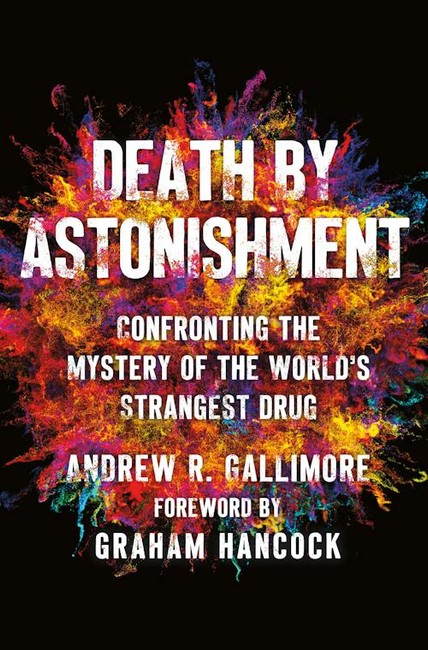 01 / 2025
Death by Astonishment: Confronting the Mystery of the World’s Strangest Drug
Our starting pick for its historical approach to DMT, based on the publisher’s description.
View book on AmazonBook & source detailsWhy this pick?
Chosen as this file’s starting point for its historical approach, based on the publisher’s description. This is an editorial selection, not a comparison of Amazon ratings or a claim of a complete independent book review.
The stamp is an editorial recommendation informed by published reviews, source quality, and relevance. It is not a claim about the highest Amazon customer rating. Selection source.
 02 / 2022
Reality Switch Technologies: Psychedelics as Tools for the Discovery and Exploration of New Worlds
His account of how psychedelics change the worlds people experience; a closer look at the brain model behind his argument.
View book on AmazonBook & source details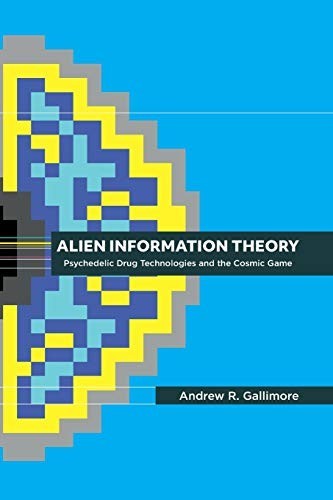 03 / 2019
Alien Information Theory: Psychedelic Drug Technologies and the Cosmic Game
The book to turn to for his speculative ideas about information, alien intelligence and the structure of reality.
View book on AmazonBook & source details
A place on this shelf is not a verdict on every claim inside. Selection checked 10 October 2026. Cover artwork belongs to its respective rights holders; cover sources & editions. Links open a specific edition. Cover artwork may show a different edition; check the format, availability, and price on Amazon before buying.
A QUESTION LEFT IN THE MARGIN / EDITORIAL PROMPT
Bring one source.
If Gallimore’s external-world interpretation is right, what could an encounter tell us that a brain-generated experience could not? Specify a test, a control and a result that would count as failure.
A useful first note: the source, what it establishes, and what it leaves open.
FOLLOW ANOTHER THREAD
Follow this thread.
Compare Gallimore’s interpretation with encounter reports, extended-state research and the separate laser-code claim.
 ENTITIES UNVERIFIEDDOSSIER 065 / FICTIONAL ART
DMT and the machine elves: the encounters, the history and the research
From McKenna’s changing creatures to the question researchers are still trying to answer: why does it feel like someone else is there?
 EXTENDED STATES MEASURED / EXTERNAL WORLD UNPROVENDOSSIER 079 / FICTIONAL ART
The DMT Expedition: Another World—or a Brain That Won’t Let Go?
The experiment changes the clock. The destination remains disputed.
 REALITY CODE UNVERIFIEDDOSSIER 066
Danny Goler: the DMT laser and the Code of Reality
A red light on a wall. A claim that the wall is hiding the machinery.