DOSSIER 010 / HIDDEN POWER
The Illuminati
The order died. The story did not.
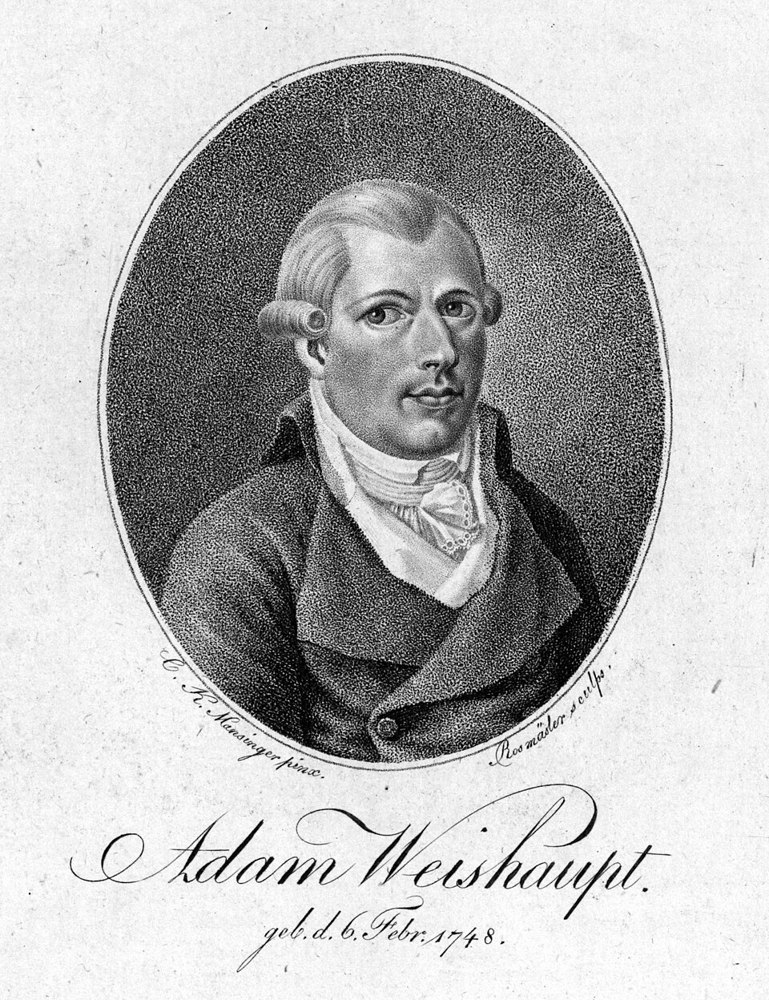
The order existed. That is the small, stubborn fact from which an enormous shadow has grown. Start in a Bavarian university, before following it into the supposed command rooms of the modern world.
01 / The professor and his recruits
In 1776, Adam Weishaupt, a professor of canon law at Ingolstadt, gathered students into a secret society. They first called themselves Perfectibilists. Their ambitions went beyond convivial dinners: education, internal surveillance, and the cultivation of an elite were intended to undermine the power of princes. LMU’s history identifies that political purpose plainly. The historical Illuminati were not invented by later conspiracy writers.
Exposure and suppression followed in the 1780s. Weishaupt lost his university position in 1785. Some former adherents subsequently returned to respectable public life. That afterlife matters: the disappearance of an organization does not make its members vanish, but the careers of former members do not establish that the organization secretly survived.
02 / The accounts closest to the order
For this file, the useful testimony is historical correspondence and institutional history, not a modern celebrity’s hand gesture. HISTORY’s account describes the order’s recruitment and the alarm it provoked. Read it beside LMU’s account of Weishaupt’s own university. Both concern a particular movement in a particular political setting. Neither provides an eyewitness to a continuing, worldwide headquarters.
John Robison supplies a more revealing voice from the period. In Proofs of a Conspiracy, his own introduction recalls finding a German periodical in a friend’s country house in 1795, then revisiting material from his earlier experiences in European lodges. He presents himself as a participant who has recognized a danger. That is his account of how his investigation began, not an independently verified account of a surviving Illuminati command structure.
03 / How believers extend the story
The enduring argument is that suppression drove the order further underground. Prominent recruits, layered initiation, and the use of secrecy become a template through which later elites are read. A symbol or association is treated as the remaining fingerprint of a concealed chain of command. The appeal is understandable: documented secrecy offers a foothold that a wholly imaginary organization would lack.
Robison’s book argues that secret societies worked against religion and government and connects their activities to revolutionary upheaval. Reading his argument directly shows the theory taking shape: genuine organizations, private documents, and political disorder are assembled into a hidden common purpose. His conviction is part of the historical story. Whether the connections establish that purpose is the dispute.
04 / Where the chain disappears
The difficult step is continuity. To connect eighteenth-century Bavaria with a modern institution requires records of membership, authority, money, or instructions across the intervening years. Similar imagery cannot carry that burden. The historical order gives this story its opening chapter; it does not supply the missing chapters that would turn modern world-control allegations into a demonstrated operation.
The allegation, in brief
A surviving Illuminati supposedly directs governments, finance, wars, and entertainment, leaving signatures in symbols and celebrity imagery.
Where the archive stands
Adam Weishaupt founded a real Bavarian society in 1776; it was suppressed in the 1780s. Historical existence does not establish a continuous, world-ruling organization. Modern lore grew far beyond the original group.
A historical order and its imagined descendants
The first useful move is to split the file. One part concerns an eighteenth-century Bavarian organization, its founders, membership, ambitions, and suppression. The other concerns a modern narrative that moves easily from a music video to a central bank to a war. A source establishing the first cannot, by itself, establish the second. Symbols acquire meanings through use; seeing one does not identify the person giving an order.
- Look for documented continuity after the historical society’s suppression.
- Require an identifiable decision or act, rather than symbolic resemblance.
- Distinguish historical scholarship from satire, fiction, and promotional claims.
Follow the alleged chain of command. A triangle cannot give orders.
ARCHIVIST’S NOTE / EXPANDED RESEARCH: 02 OCT 2026
THE SHELF BEHIND THE FILE
For further reading
Take the longer trail. These are the books we would keep beside this file.
As an Amazon Associate I earn from qualifying purchases. Purchases through these links may earn this archive a commission.
- THE WATCHER’S
FAVORITE 01 / Historical scholarship
Conspiracies of Conspiracies
Follow the recurring hidden-hand stories through American history.
Find editions on AmazonBook & source detailsWhy this pick?
Praised in the American Historical Review and recommended by Choice; review excerpts appear on the university press page.
The stamp is an editorial recommendation informed by published reviews, source quality, and relevance. It is not a claim about the highest Amazon customer rating. Selection source.
 02 / Political / religious studies
A Culture of Conspiracy
How UFO lore, secret governments, and apocalyptic expectations became entangled.
View book on AmazonBook & source details
A place on this shelf is not a verdict on every claim inside. Selection checked 2 October 2026. Cover artwork belongs to its respective rights holders; cover sources & editions. Covers identify a selected edition; Amazon lists current editions, availability, and prices.
A QUESTION LEFT IN THE MARGIN / EDITORIAL PROMPT
Bring one source.
What evidence would connect the historical Bavarian order to a specific modern decision? A shared symbol is the starting point, not the connection.
A useful first note: the source, what it establishes, and what it leaves open.
FOLLOW ANOTHER THREAD
Adjacent files
 UnsupportedDOSSIER 011
Freemasons and the invisible government
A closed door is an invitation to invent the room.
![Collectie / Archief : Fotocollectie Anefo
Reportage / Serie : [ onbekend ]
Beschrijving : Oosterbeek Hotel "De Bilderberg" , conferentiecentrum
Datum : 30 mei 1954
Locatie : Oosterbeek
Fotograaf : Fotograaf Onbekend / Anefo
Auteursrechthebbende : Nationaal Archief
Materiaalsoort : Glasnegatief
Nummer archiefinventaris : bekijk toegang 2.24.01.09
Bestanddeelnummer : 906-4935](/assets/bilderberg.jpg) UnsupportedDOSSIER 012
UnsupportedDOSSIER 012Bilderberg
Powerful people. A meeting without a transcript.
 UnsupportedDOSSIER 013
Skull and Bones
A tomb in New Haven, enlarged to fit the world.