DOSSIER 083 / SPACE & SKIES
3I/ATLAS: comet or alien spacecraft? The observations and email rumor
A visitor from another star system acquired a second life in a story about secret contact.
Unsupported applies to the spacecraft and secret-contact claims; it does not dispute the object’s interstellar origin or imply a finding of misconduct by researchers.
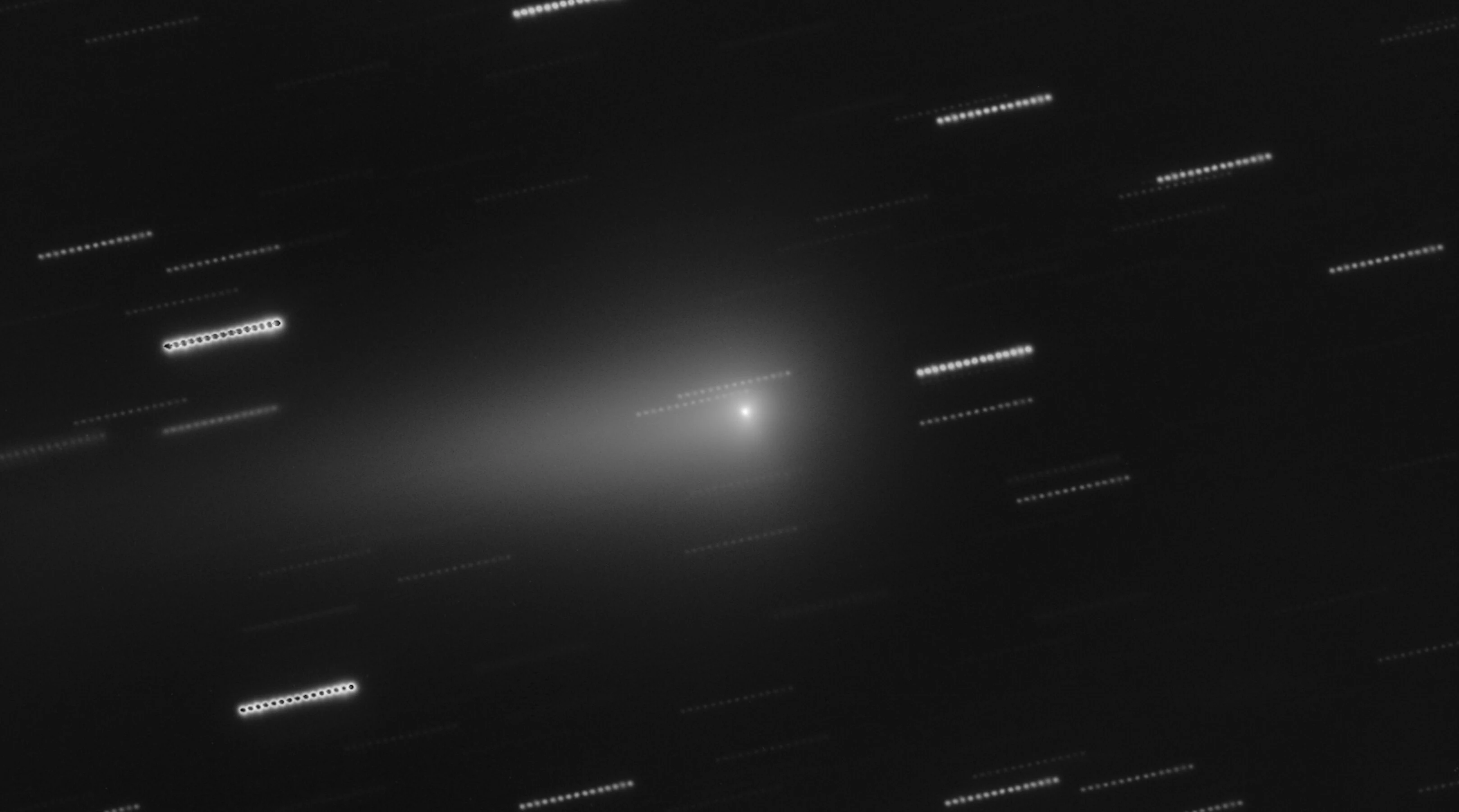
On 18 October 2026, an online discussion described a supposedly misdirected government email about beings aboard 3I/ATLAS. By then, astronomers had spent more than a year measuring the visitor. To understand why a secret-message story could attach itself to this object, we have to return to the telescope in Chile, the researchers who proposed a technological explanation, and the instruments that went looking for evidence. The comet is real. The alleged correspondence has not been authenticated. Their histories need to be followed separately.
01 / The visitor in the survey images
On 1 July 2025, a survey telescope in Rio Hurtado, Chile, reported a moving object to the Minor Planet Center, the clearinghouse where astronomers collect positions of small bodies. The instrument belonged to ATLAS, the Asteroid Terrestrial-impact Last Alert System. Earlier images subsequently extended the observing record back to June 14. There was already a trail to follow before anyone had named the object.
Its designation, 3I/ATLAS, carries the essential discovery: the third confirmed interstellar object. Its path was hyperbolic, an open trajectory through the solar system rather than a closed circuit around the Sun. Astronomers could trace that path backward to an arrival from outside our system. Coming from another star system made it extraordinary before anybody proposed a spacecraft.
NASA’s observing timeline follows an expanding effort involving telescopes on Earth and instruments in space, including spacecraft near Mars. The point of so many viewpoints was to learn what a faint, moving object was made of and how it changed. A remote image records light from the object and its surroundings; it does not give us a close-up of its surface.
02 / How a comet became a possible mission
On July 16, Adam Hibberd, Adam Crowl and Abraham Loeb submitted a paper asking whether the visitor could be technology. Their abstract described the work as largely a teaching exercise. It nevertheless explored a striking possibility: an intelligent visitor taking advantage of its route through the solar system. The authors discussed its orbital orientation, planetary approaches and the period when the Sun would obstruct observation from Earth.
Their scenario included a hypothetical braking maneuver near the Sun. A spacecraft could, in principle, exploit the geometry of a close solar passage to change its motion. That is why the paper attracted attention beyond astronomy: it described what an approaching machine might be able to do. It did not report an observed engine burn.
The paper also invoked the Dark Forest idea, in which civilizations might conceal themselves because contact could be dangerous. That supplies a possible motive within a speculative scenario. It cannot tell us what this particular object is. A convincing artificial-origin case still has to connect an observation to a mechanism that works better than the competing physical explanations.
03 / The jets that looked purposeful
Images showing structure around the visitor kept the argument alive. In an April 2026 preprint, Toni Scarmato and Loeb compared the apparent directions of three jets with components of the object’s non-gravitational acceleration. That phrase means motion beyond the calculated gravitational contribution; it does not identify the cause of the extra push.
Their analysis projected three-dimensional directions onto the sky and estimated thrust through several intermediate steps, from measured light to dust cross-section, mass loss and momentum. They explicitly discussed uncertainty from background subtraction, scattering assumptions and the missing dimension along the line of sight. Those steps matter when a processed image is circulated as a photograph of thrusters.
A jet’s direction is an observation to explain. Calling it an engine adds a claim about the machinery producing it. The preprint’s calculations deserve examination on their own terms, but a suggestive shape cannot by itself supply the missing machinery. Readers can follow the authors’ analysis in the Paper Trail rather than rely on a cropped image with a caption already announcing the answer.
04 / What the infrared instruments found
Webb’s Mid-Infrared Instrument took observations in December 2025 as 3I/ATLAS moved away from the Sun. The mission team’s June 1 account described a direct detection of methane and an unusually high abundance relative to water. Carbon dioxide also remained abundant. These were measurements of escaping gases, not a report of a manufactured material.
The researchers interpreted the delayed appearance of methane as consistent with volatile ice that had been protected below the surface until heat penetrated deeper. They also observed gas production falling as the object receded and cooled. The mix was unusual compared with most solar-system comets, while its changing activity could be investigated through heating and sublimation, the transition from solid ice directly to gas.
This changes the question an anomaly raises. A visitor formed elsewhere need not carry the same chemical proportions as the objects used to define our local expectations. An unfamiliar mixture is a valuable clue to its history. Deciding whether it requires technology means comparing explanations against the measured behavior, including how that behavior changes with distance from the Sun.
05 / The chemical record of somewhere else
A second Webb account, published June 22, followed a team led by astrochemist Martin Cordiner. Spectroscopy breaks light into wavelengths so researchers can identify molecules and compare their abundances. Here they examined carbon and deuterium, a heavier form of hydrogen. NASA reported exceptionally high deuterium levels, about thirty times those seen in solar-system comets.
The team used those measurements to work backward toward a very cold formation environment earlier in the galaxy’s history. That is an inference from chemistry, with assumptions about how the material formed and changed. It gives the object a possible natural biography extending far beyond the brief interval when our telescopes could follow it.
On July 6, the European Southern Observatory described a separate investigation using the Very Large Telescope. Cyrielle Opitom and colleagues measured carbon and nitrogen isotope ratios in cyanide gas around the comet. Isotopes are forms of an element with different numbers of neutrons. Their relative abundances can preserve information about the conditions in which material formed.
The ESO team’s interpretation favored formation in the outer region of an old star system with relatively few heavy elements. Their work and the Webb results pointed toward an object older than the Sun. This does not identify its birthplace on a map, or give a directly measured birthday. It does supply a reason that something natural from elsewhere could differ markedly from familiar comets.
06 / The observers who actually searched for a signal
Researchers did not have to settle the spacecraft argument before looking for evidence of technology. Sofia Sheikh and colleagues used the Allen Telescope Array to observe 3I/ATLAS over frequencies from one to nine gigahertz. Their study analyzed 7.25 hours of data. The initial search returned nearly seventy-four million narrowband hits, most of which required filtering for interference.
A hit is a feature selected by a search program. It becomes interesting only after the team asks where it came from and whether it behaves like interference from human equipment. After several filtering stages, the researchers visually inspected 211 remaining hits and found none worth additional follow-up. The revised paper was accepted for the Astronomical Journal.
Breakthrough Listen’s observing record also describes work with MeerKAT and Green Bank. It reports no artificial radio emission localized to 3I/ATLAS in those searches. Its public data section lets technically equipped readers examine observations themselves. The negative results have boundaries: frequencies, sensitivity, observing periods and the kinds of signal sought. They do not rule out every imaginable quiet machine. They provide a test whose result can be stated and checked.
07 / The secret email arrives after the observations
The immediate reason for reopening this story is a new online claim. An October 18 discussion on r/aliens described a video seen on X, supposedly originating on TikTok, about a government worker receiving an email by mistake. The poster said the email concerned communication with beings aboard 3I/ATLAS and recalled a date in December 2025. The same post tried to connect it to an older account the writer could no longer find.
That is a record of somebody describing material encountered elsewhere. The post establishes that the story is circulating; it does not authenticate an email, identify its sender or establish contact. This archive has not independently authenticated the underlying message or the claimed original video. There is no basis here to assign the alleged knowledge to any named scientist.
The chain matters because each retelling can remove information needed to check it. Before treating such a document as a new discovery, I would want the original file, its provenance, a verifiable sender and recipient, and independent records supporting its contents. A plausible-looking format is easy to circulate. An independently checkable history is much harder to supply.
08 / What remains open
As of October 19, 2026, the reviewed observations support an interstellar comet with unusual chemistry. The technological interpretation remains unsupported by the evidence examined here. The radio searches found no qualifying artificial signal; the chemical studies offer testable natural histories. Those conclusions concern the record in this file, and can change if better evidence appears.
The next useful contribution would be a measurement that distinguishes the explanations: a repeatable signal localized to the object, a demonstrated maneuver that survives independent analysis, or authenticated documents whose contents can be corroborated. The proposed explanation should say what finding would count against it as clearly as what would count for it.
For a reader trying to untangle the current rumor, start with the original observing papers and keep a separate folder for the alleged email. The evidence needed to validate a radio observation differs from the evidence needed to authenticate correspondence. Mixing them makes a long list of intriguing details, but leaves the central claim harder to test.
QUESTIONS LEFT ON THE DESK
The questions readers bring.
FAQ & search review: 2026-10-19 · Source links identify the record behind each answer. This date does not certify a new investigation of every chapter.
Is 3I/ATLAS an alien spacecraft?
The reviewed evidence supports an interstellar comet. A published hypothesis considers technology, but the observations examined here do not establish an artificial origin.
Did researchers receive an artificial radio signal from 3I/ATLAS?
The Allen Telescope Array study found no candidates worth follow-up. Breakthrough Listen also reports no artificial emission localized to the object in its listed MeerKAT and Green Bank searches. These results apply to the signals and observing windows searched.
Has the alleged secret-contact email been authenticated?
No authenticated email is established by the material reviewed for this file. The October discussion is evidence that a rumor circulated, not independent evidence of its contents.
Compare the records: The UAP crash-retrieval cover-up · Roswell · Project Blue Book suppression.
The allegation, in brief
3I/ATLAS may be an alien spacecraft, with alleged secret correspondence offered as evidence of contact.
Where the archive stands
The discovery, unusual chemistry and research into jets are documented. Reviewed radio searches found no qualifying artificial signal. The alleged email is unauthenticated.
I would want the original message and its provenance before letting it outweigh the observing record.
ARCHIVIST’S NOTE / EXPANDED RESEARCH: 19 OCT 2026
THE SHELF BEHIND THE FILE
For further reading
Sagan supplies tools for evaluating extraordinary claims; Barkun supplies the cultural history of UFO secrecy stories. Neither book investigates 3I/ATLAS.
As an Amazon Associate I earn from qualifying purchases. Purchases through these links may earn this archive a commission.
- THE WATCHER’S
FAVORITE 01 / Science / critical thinking
The Demon-Haunted World
A working kit for examining extraordinary claims without losing your sense of wonder.
View book on AmazonBook & source detailsWhy this pick?
Los Angeles Times Book Prize winner; favorable reviews from the Los Angeles Times and Washington Post, documented by the publisher.
The stamp is an editorial recommendation informed by published reviews, source quality, and relevance. It is not a claim about the highest Amazon customer rating. Selection source.
 02 / Political / religious studies
A Culture of Conspiracy
How UFO lore, secret governments, and apocalyptic expectations became entangled.
View book on AmazonBook & source details
A place on this shelf is not a verdict on every claim inside. Selection checked 19 October 2026. Cover artwork belongs to its respective rights holders; cover sources & editions. Links open a specific edition. Cover artwork may show a different edition; check the format, availability, and price on Amazon before buying.
A QUESTION LEFT IN THE MARGIN / EDITORIAL PROMPT
Bring one source.
Which independently repeatable observation would most clearly distinguish a natural comet from a technological object, and what result would count against your preferred explanation?
A useful first note: the source, what it establishes, and what it leaves open.
FOLLOW ANOTHER THREAD
Follow this thread.
Compare an unidentified observation with a specific claim about alien technology.
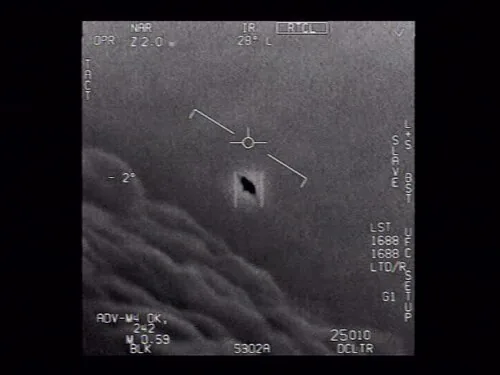 UnsupportedDOSSIER 021
The UAP crash-retrieval cover-up
An unexplained sighting is where the inquiry begins.
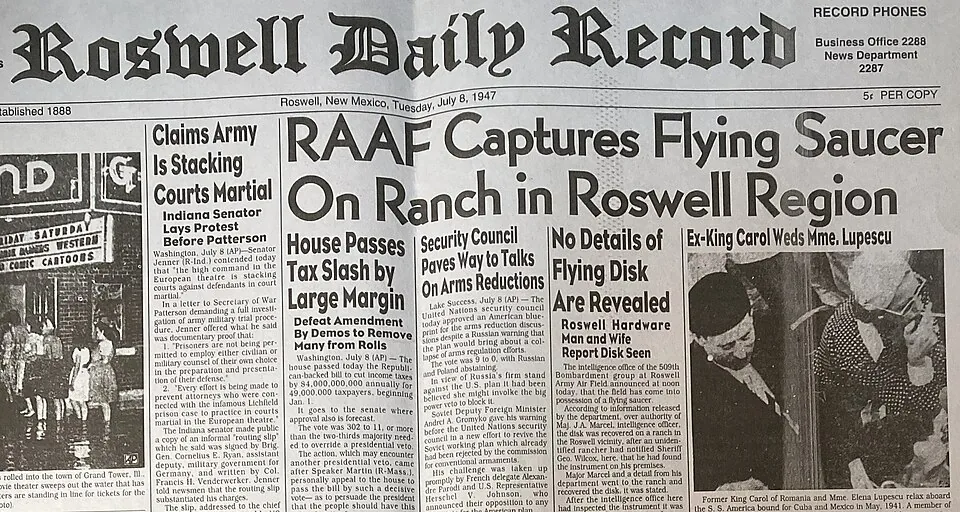 UnsupportedDOSSIER 018
Roswell
Debris in the desert. Decades in the imagination.
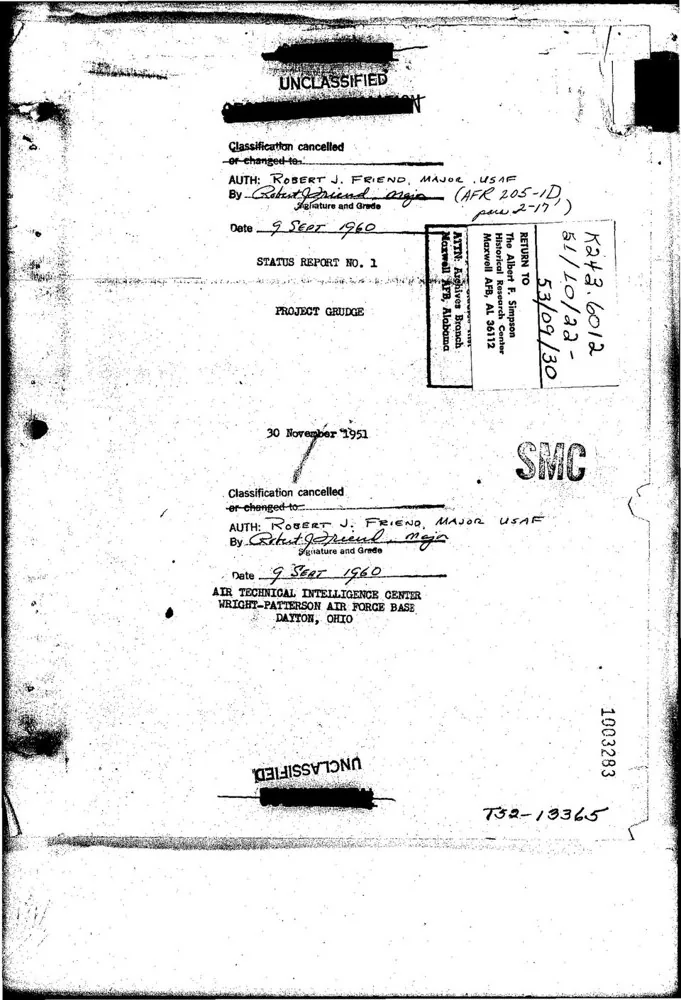 UnsupportedDOSSIER 022
Project Blue Book suppression
A real investigation with a much larger legend.